
Subfamily Anthracinae
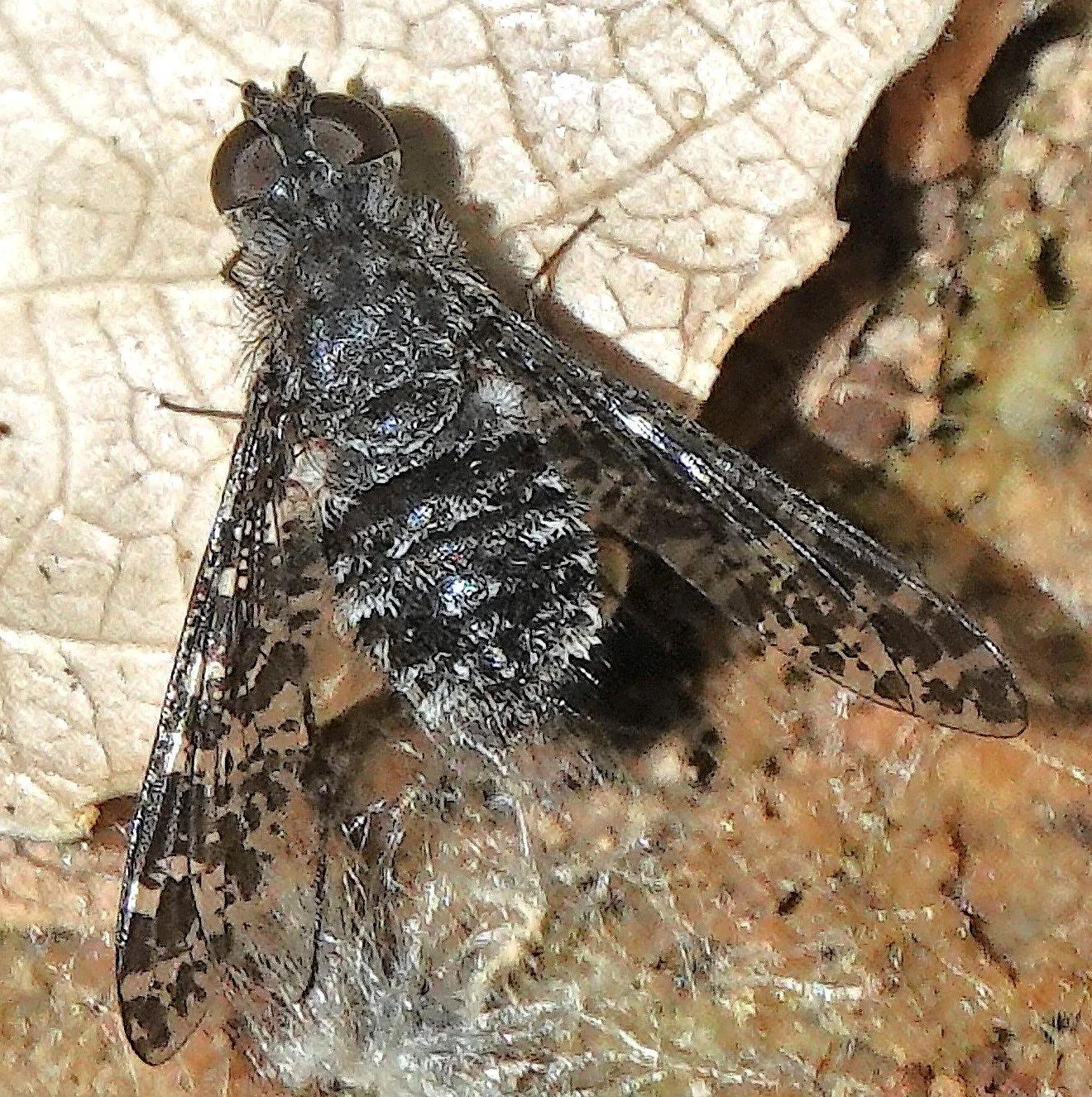
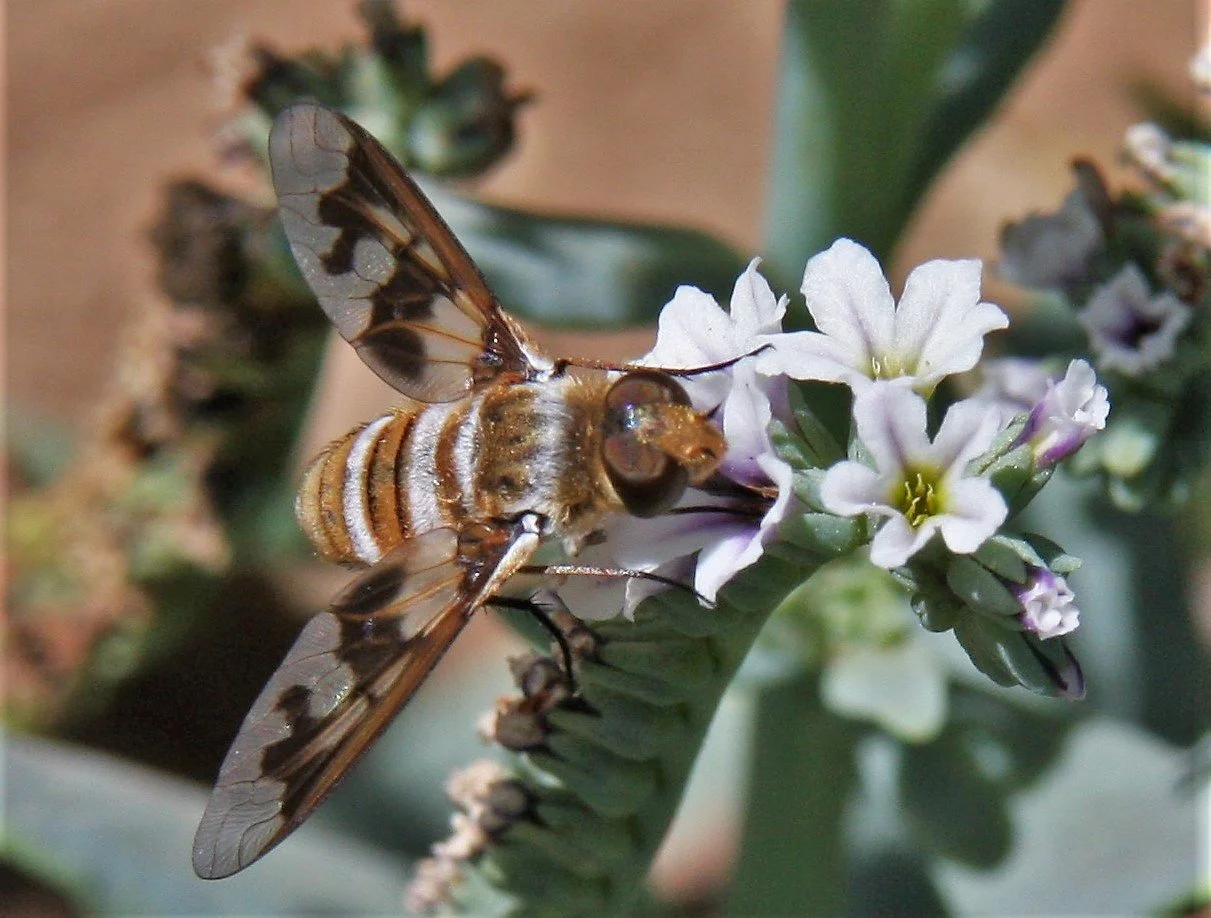

Members of this genus exhibit a short proboscis and a brush of hairs at the tip of the antennae. The second and third submarginal veins' origins are rectangular, often with backward spurs, and there are usually, but not always, two submarginal cells. Some species are reliably identifiable only with dissection. Immatures parasitize mud-built wasp nests and larvae of tiger beetles (Cicindelidae).
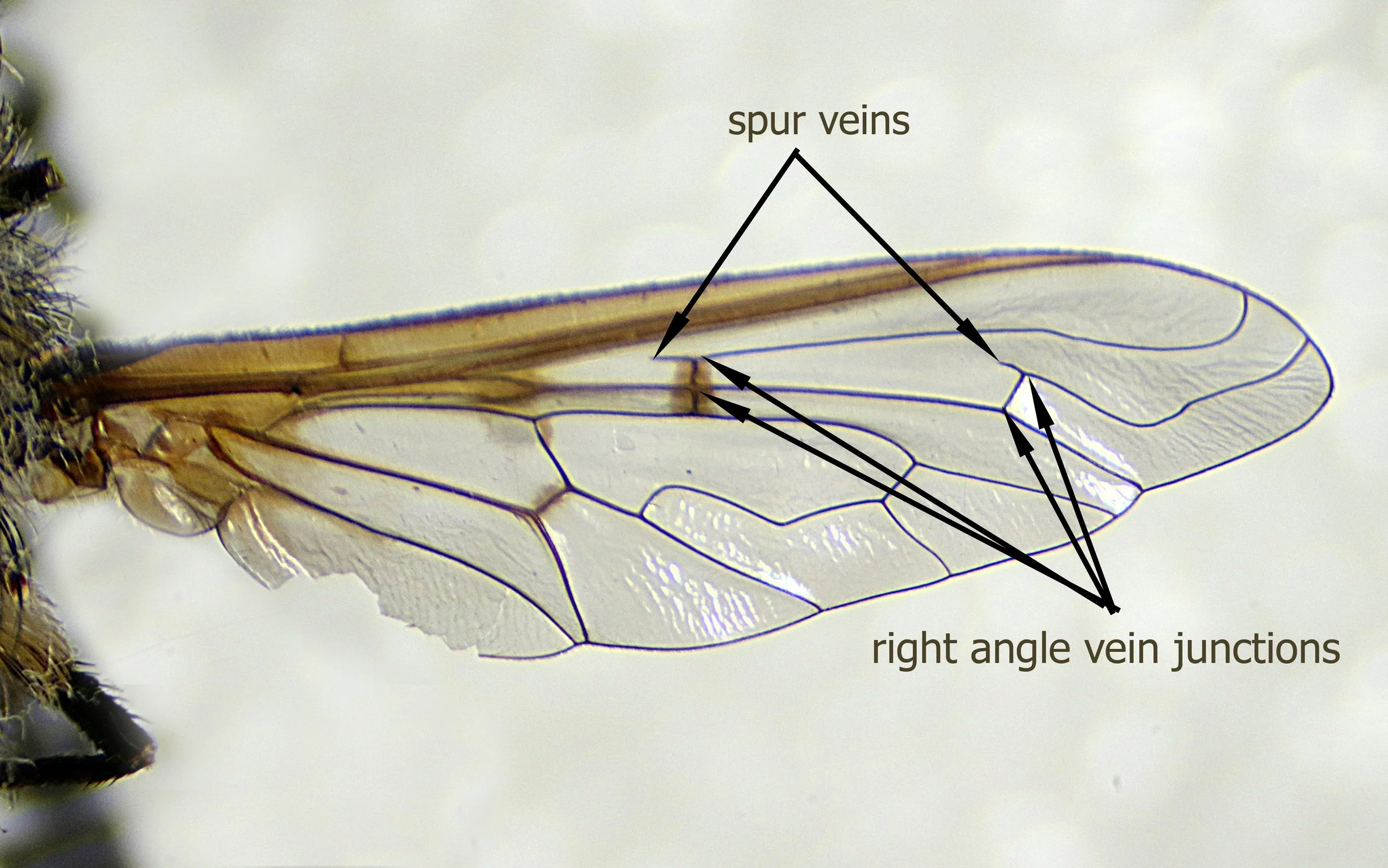
Spur Veins
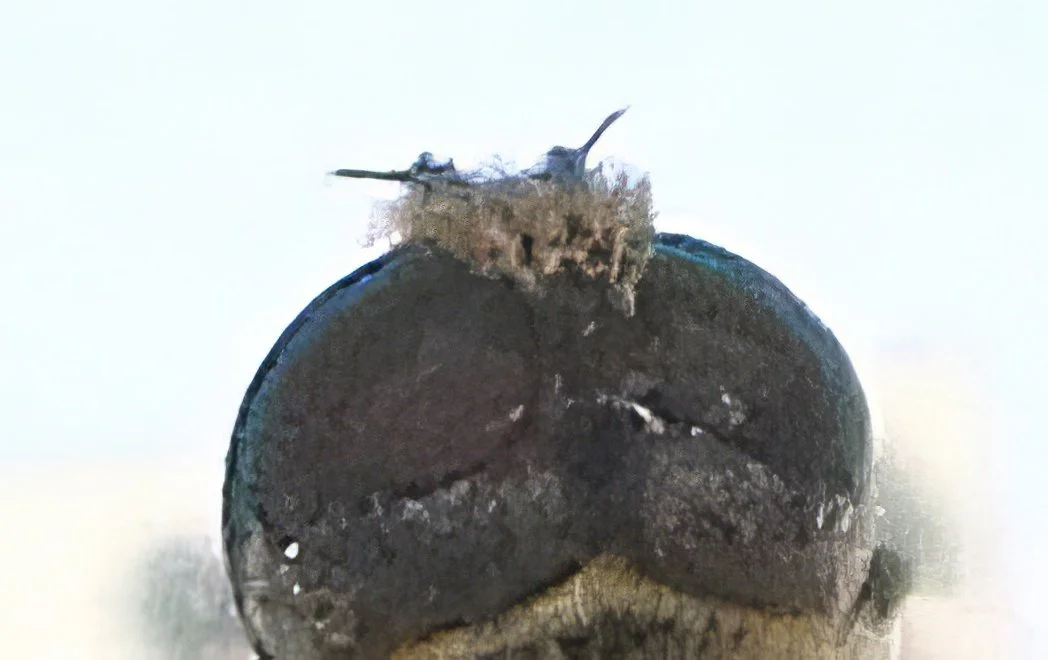
Head
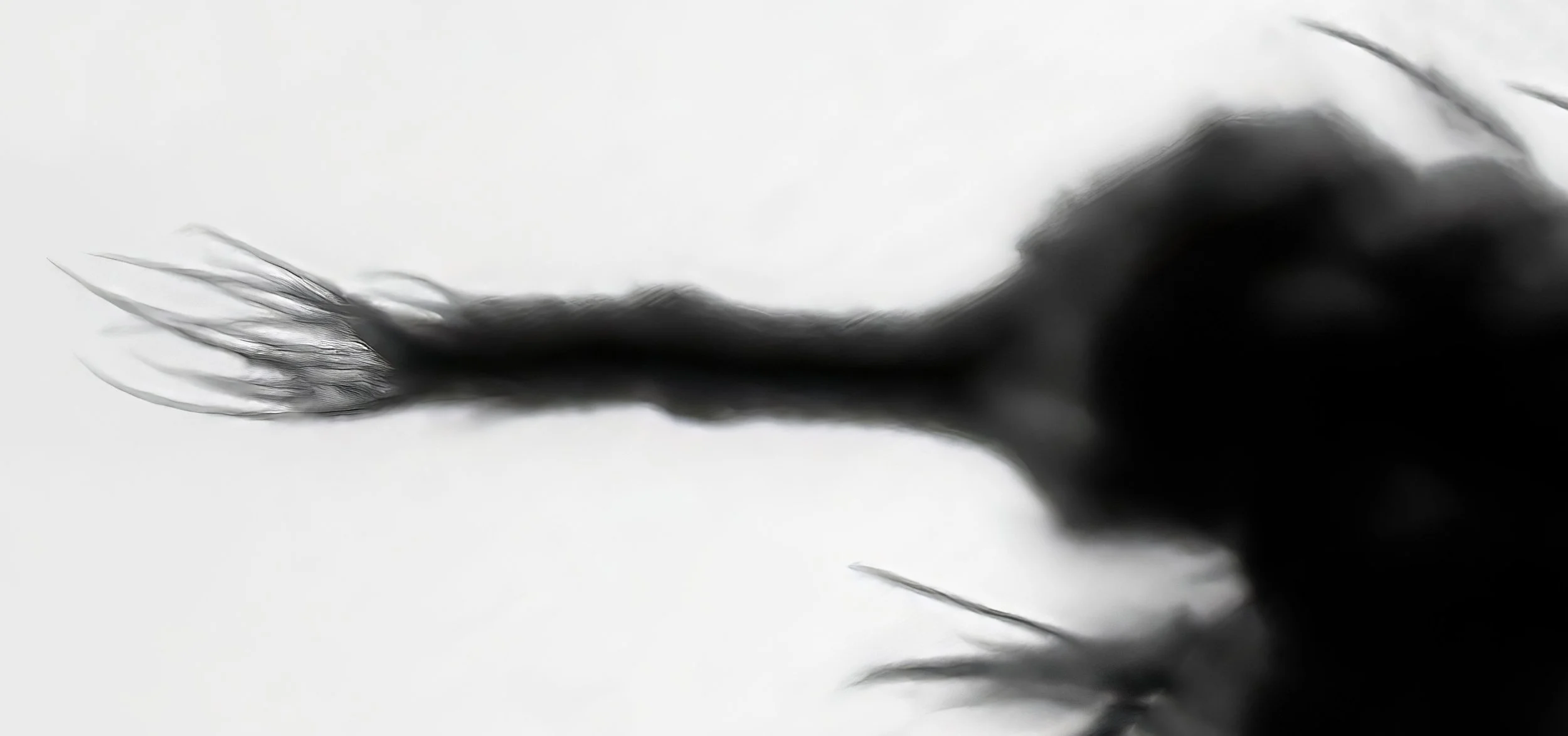
Brush-tipped Antennae
Species in this genus of more than 80 taxa are generally fairly small. The abdomen is usually tapered, and the antennae are short with a variable 3rd segment. Adults are not often found at flowers and are more likely to be seen perched on sandy soils. Melander (1950) bemoans the difficulties in species identification, stating that collectors should use care in transferring specimens from "...net to killing bottle...and kept isolated until pinned because the body covering of tomentum and pile rubs off too easily and denuded specimens are almost worthless for identification." Their wings sometimes have backwards-facing spurs, and the scutellum, although usually entire (smooth), is bilobed in a few species. In some taxa, identification is best accomplished in hand, in a jar, or on a pin, when the leg, face, and frontal coloration, antennal shape, and characters of the scutellum can all be seen. Note that many of the species are sexually dimorphic and examination of individuals of both sexes can help with identification. The larvae typically parasitize locust (grasshopper) eggs. Tribe Aphoebantini.
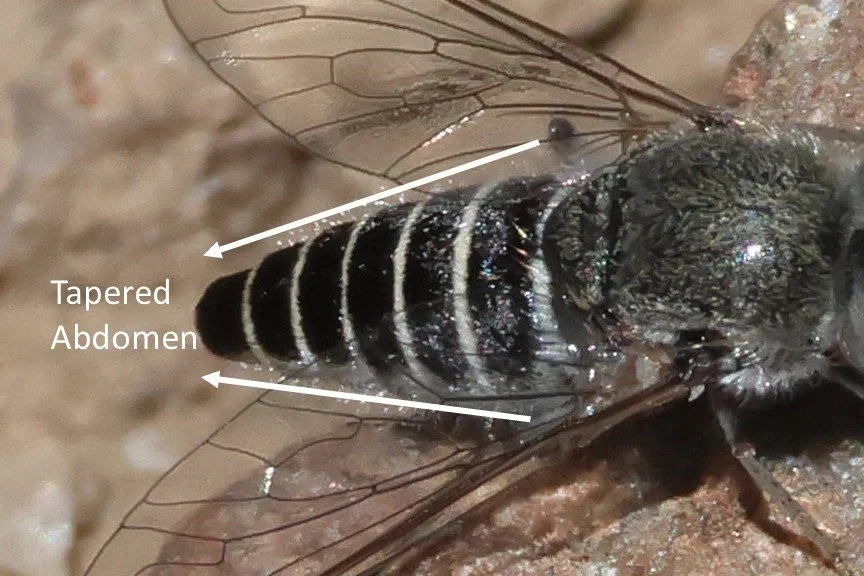
Tapered Abdomen
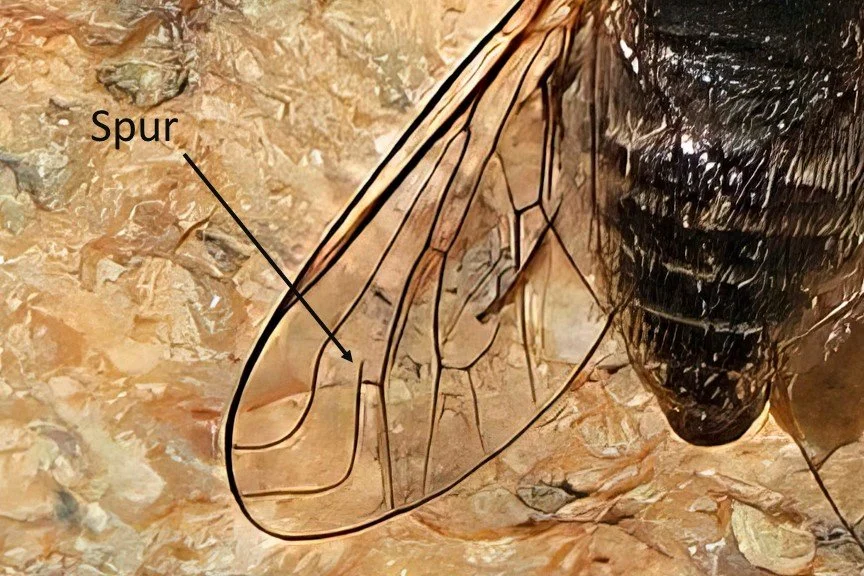
Back Facing Spur
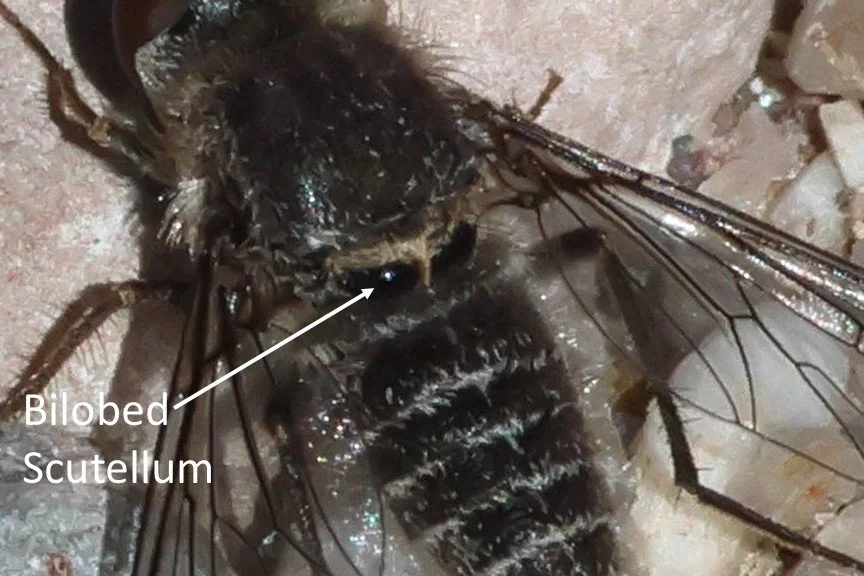
Bilobed Scutellum
This is a genus of small, black species with short antennae, and a closed but unstalked anal cell. They are typically found on sandy substrates. Tribe Villini.
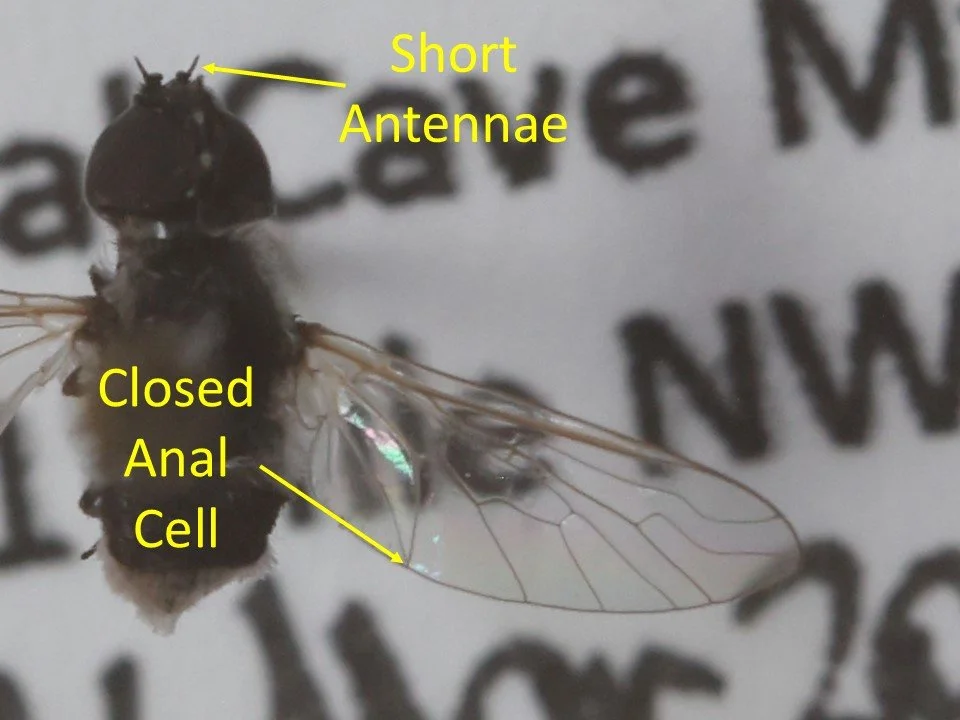
Short Antennae & Closed Anal Cell
This genus is poorly defined. Apparently, it includes medium-sized flies, often with dark or tan sharply-edged infuscation on the basal half of the wings. The taxa we include typically have a pointed face, some degree of golden coloration, and always smooth front tibiae. Adults favor low-growing flowers, especially composites. The larvae parasitize scoliid wasps. Of the several dozen known species, 17 have been reported from Arizona, 13 of which are known from our region.
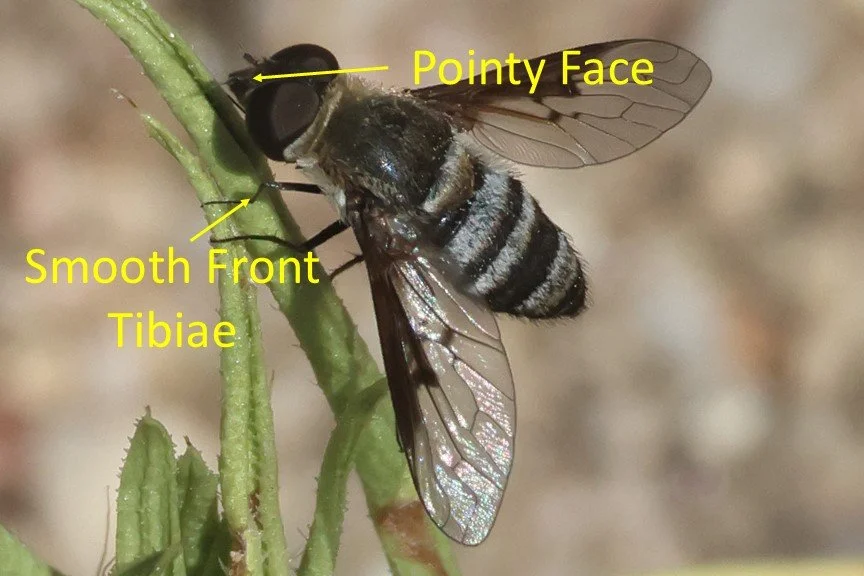
Pointy Face and Smooth Front Tibiae
The front of the ♂'s head of this little-known species is white and strongly swollen; on the ♀'s, front, the chitin is very dark, surrounded by pale gray pile. Also in both sexes, the abdomen is slender, the pile varying from tan to rose-colored. Sexual size differences enumerated in various sources are inaccurate. The genus is monotypic and the sole regional member of the Tribe Xeramoebini.
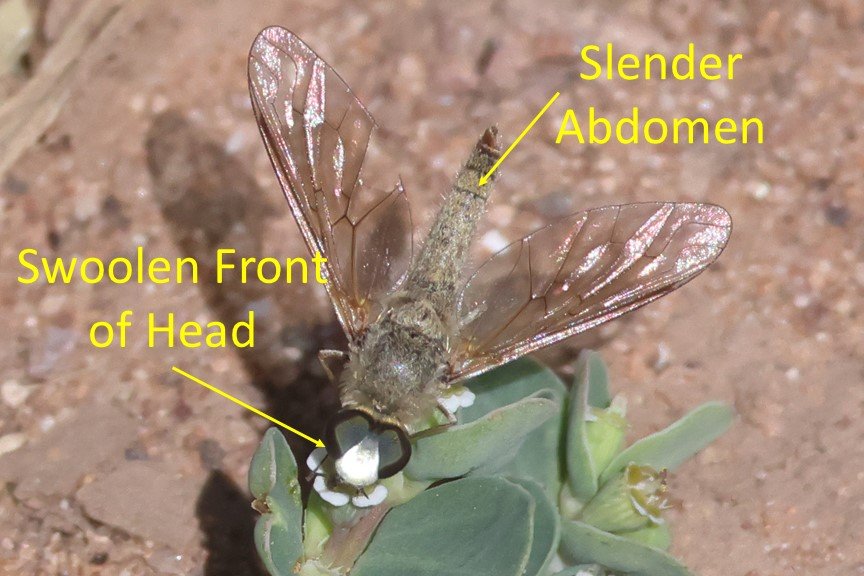
Swollen Front of Head & Slender Tapered Abdomen
Members of this predominantly California genus are similar in appearance to Anthrax. In contrast, Diochanthrax lacks the feathered antennal tips and is currently placed in the Tribe Villini.
The wings of this genus are highly patterned. The 2nd longitudinal vein is particularly s-shaped and there are invariably 3 submarginal cells. Its larvae are parasitic on antlions. The body length is usually close to 10 mm.
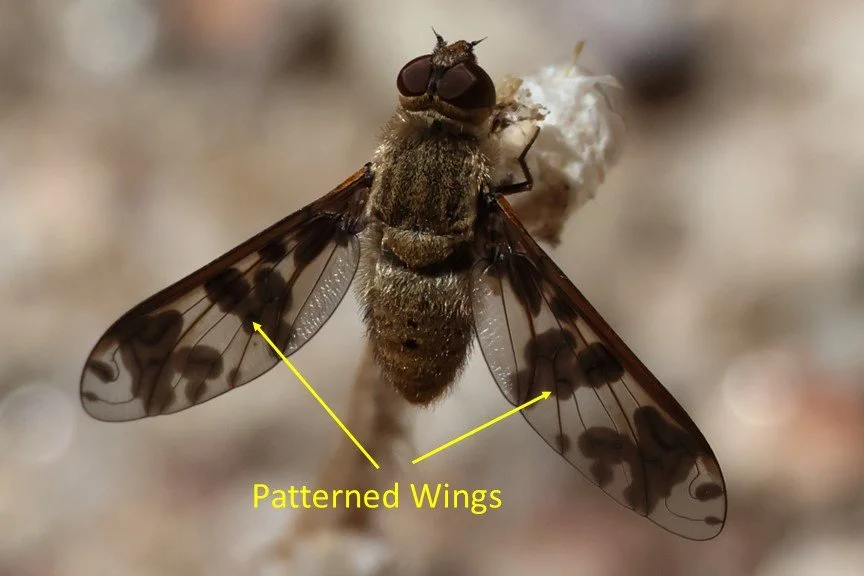
Patterned Wings
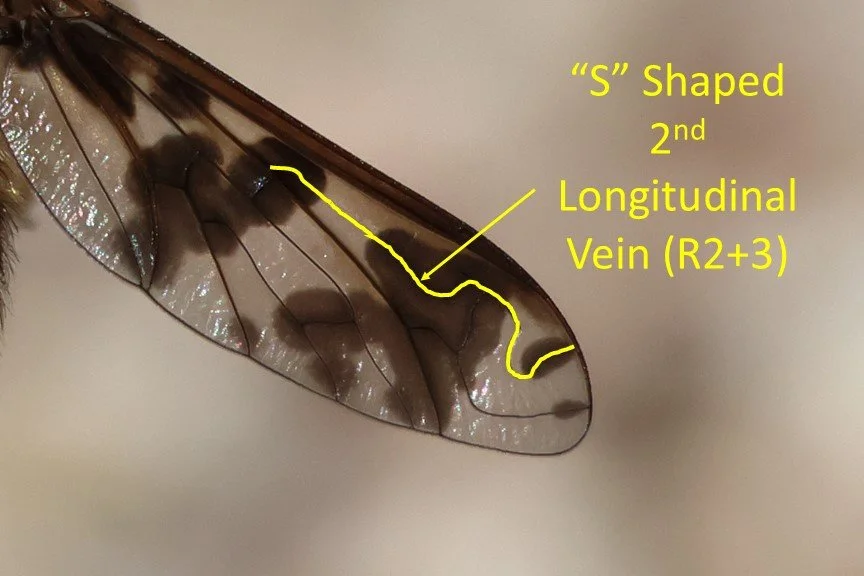
“S” Shaped R2+3
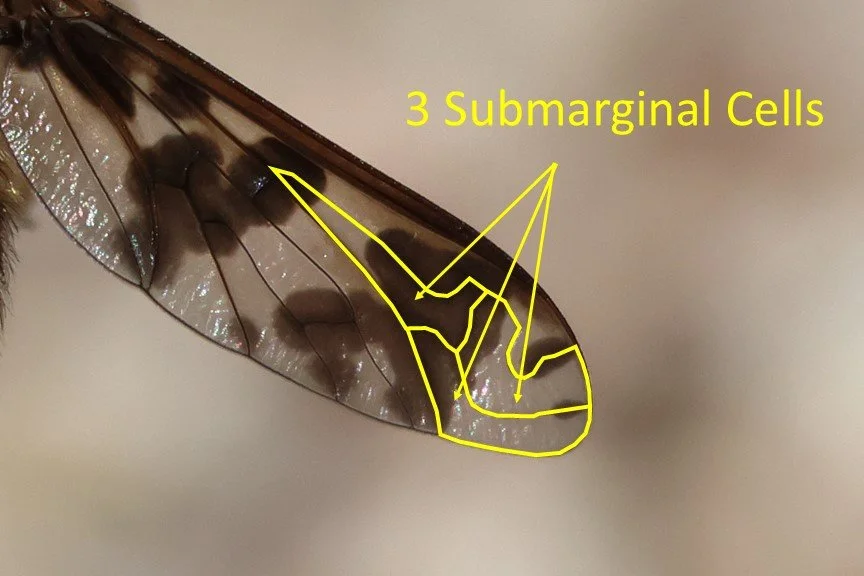
3 Submarginal Cells
Species in this genus typically have two submarginal cells, a relatively long proboscis, and long 3rd antennal segments. Note especially that R2+3 meets the 3rd longitudinal vein at an acute angle basal to the anterior crossvein. Adults are usually found on the ground rather than at nectar. Many characters in Epacmus, Eucessia, and Aphoebantus, the three members of the Tribe Aphoebantini, have been delineated and discarded over the years (Melander 1950). What remains for Epacmus is a protruding proboscis (although not in litus); in addition, usually the 3rd segment of the antenna has a bulbous base and a "slender styliform projection," and shiny black, "protruding" face (however that is defined) and males often show concave abdominal sides and enlarged segments toward the apex of the abdomen.
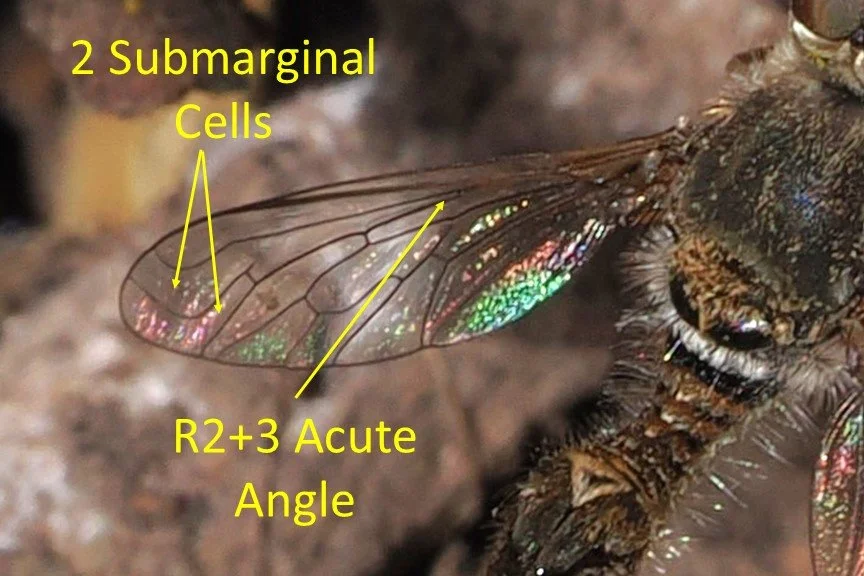
2 Submarginal Cells & R2+3 Acute Angle at 3rd Longitudinal Vein
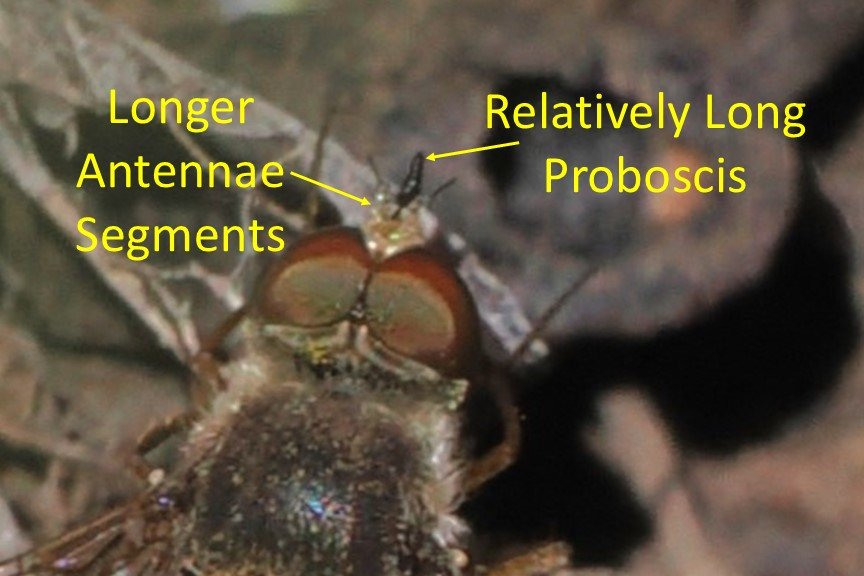
Longer Antennae Segments & Proboscis
Somewhat closely related to both Aphoebantus and Epacmus, this genus has similar venation to both those genera with vein R2+3 arising acutely well basal to the RM crossvein. It differs from both of those genera primarily in the smaller size, the tapering, cylindrical abdomen and details of the male genitalia. Although there appears to be more than one species in the genus, only 1, a California taxon, has been described.
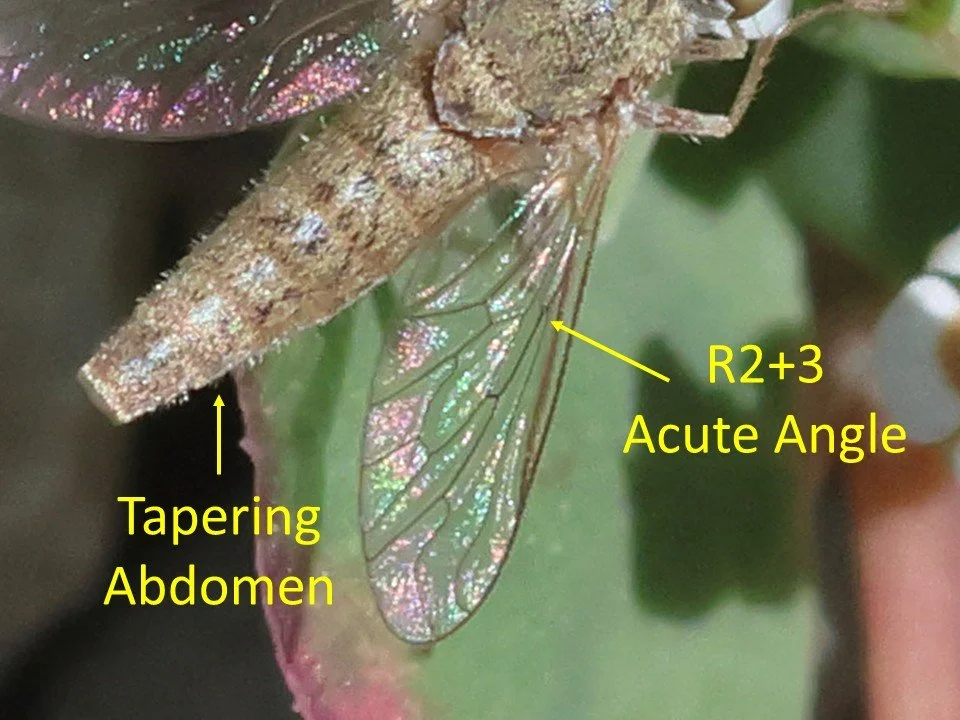
2 Submarginal Cells & R2+3 Acute Angle at 3rd Longitudinal Vein
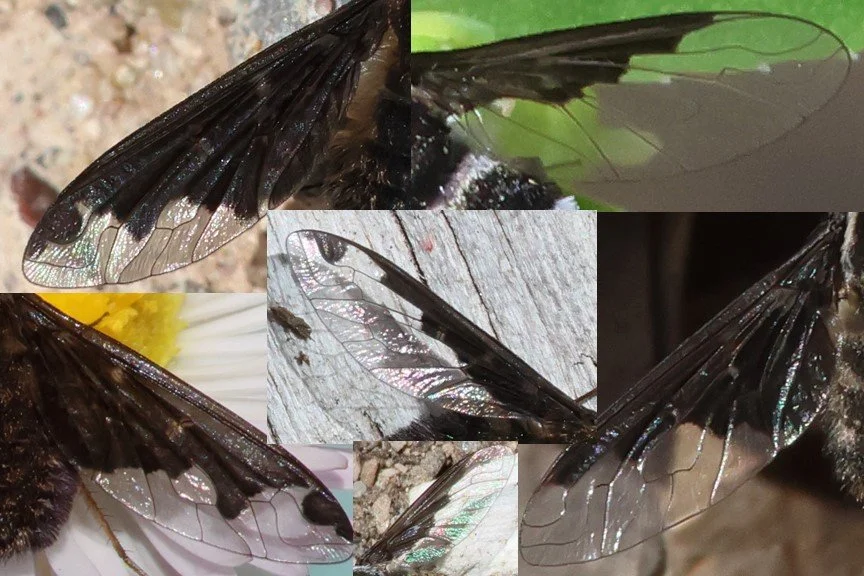
This is a well-known, worldwide genus with over 400 described species and a number that remain undescribed. The genus is especially diverse in the American Southwest and adjacent Mexico; don’t be surprised to see half dozen species occurring together. A number of Exoprosopa are segregated by elevation, a possible aid with identification. Note however that the elevational limits of many are poorly defined beyond “desert” or “mountain” species. The 3rd antennal segment has a movable, apical (“at the tip”) bristle known as a style; the proboscis varies from short to long, depending on the species. There are always 3 submarginal cells. Adults visit a variety of flowers and are certainly effective pollinators. The immatures are parasitoids of bee, wasp, and beetle larvae. While not feeding, many species perch on the ground, rocks, or downed vegetation. DIFFICULTIES - Species with a darkened leading edge on the wing are referred to as the “fasciate wing group” (This aligns with the Curran’s 1930 key as opposed to BugGuide’s “fasciata group"). Those with patterned infuscation are referred to as the “patterned group.” While most species with patterned wings seem to be identifiable from photos, many of the “fasciate wing group” are problematic. Proboscis length and style length, as well as the size and crispness of the fasciated area of the wing and the extent of wing infuscation all need to be considered for IDing E. brevirostris, E. clarki, E. dodrans, E. dodrina, E. doris, E. filia, E. junta, E. lutzi, E. pardus, E. socia, and E. texana and probably others. For a few, identification with available keys may be inconclusive and determination to species may be impossible. However, the use of DNA barcoding, currently in progress, could well help to resolve these problematic issues of systematics. Note that names in quotation marks are placeholders from BugGuide and will change as taxonomy is updated.
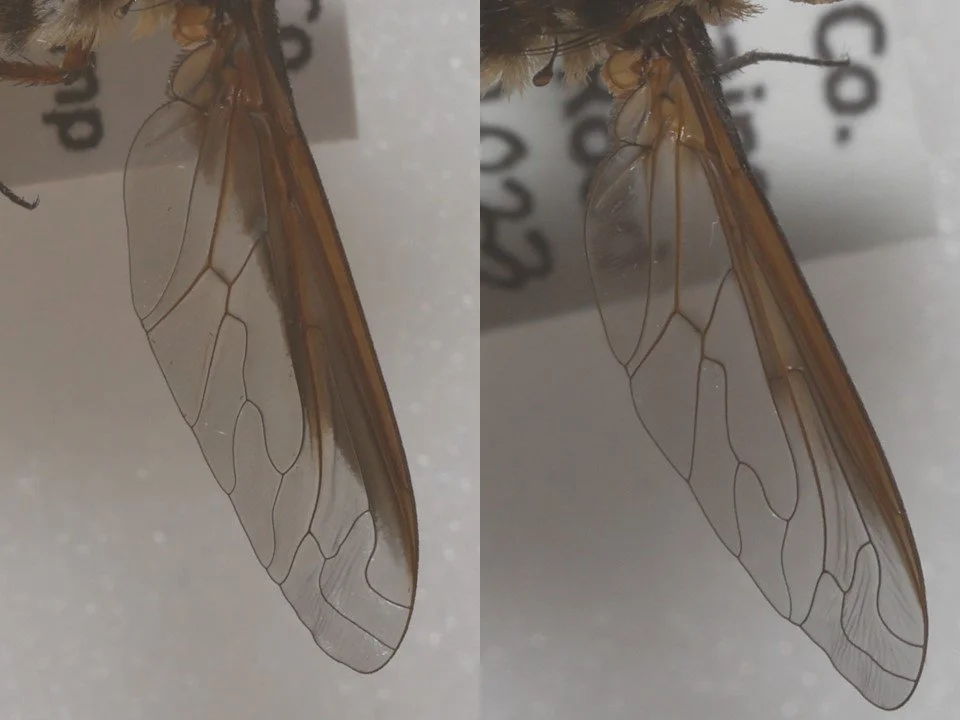
Wings of “Fasciate Wing Group”
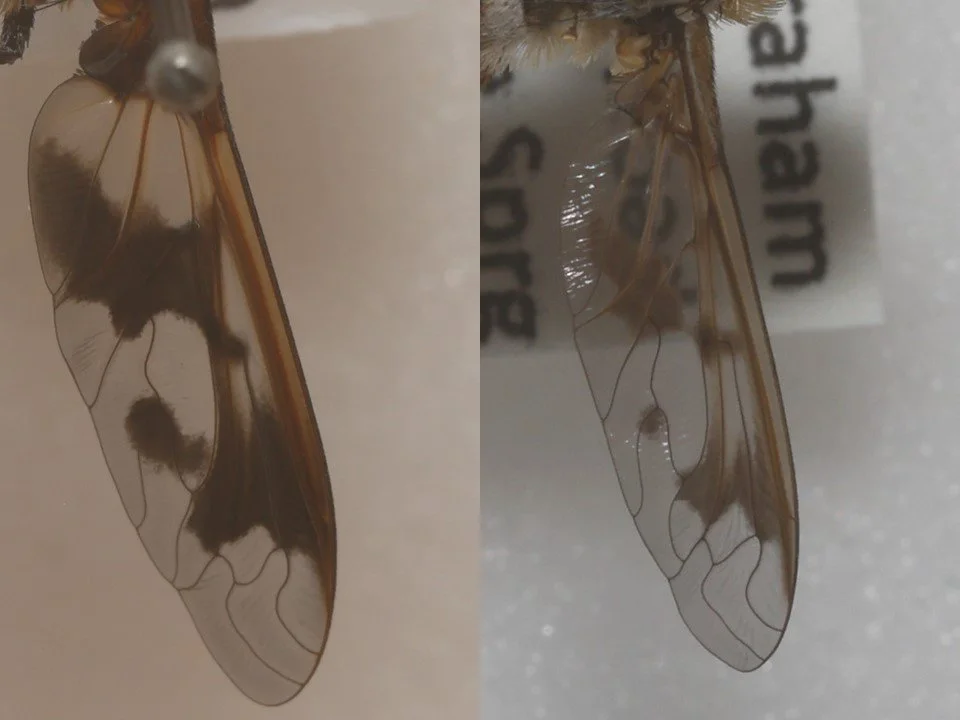
Wings of “Patterned Group”
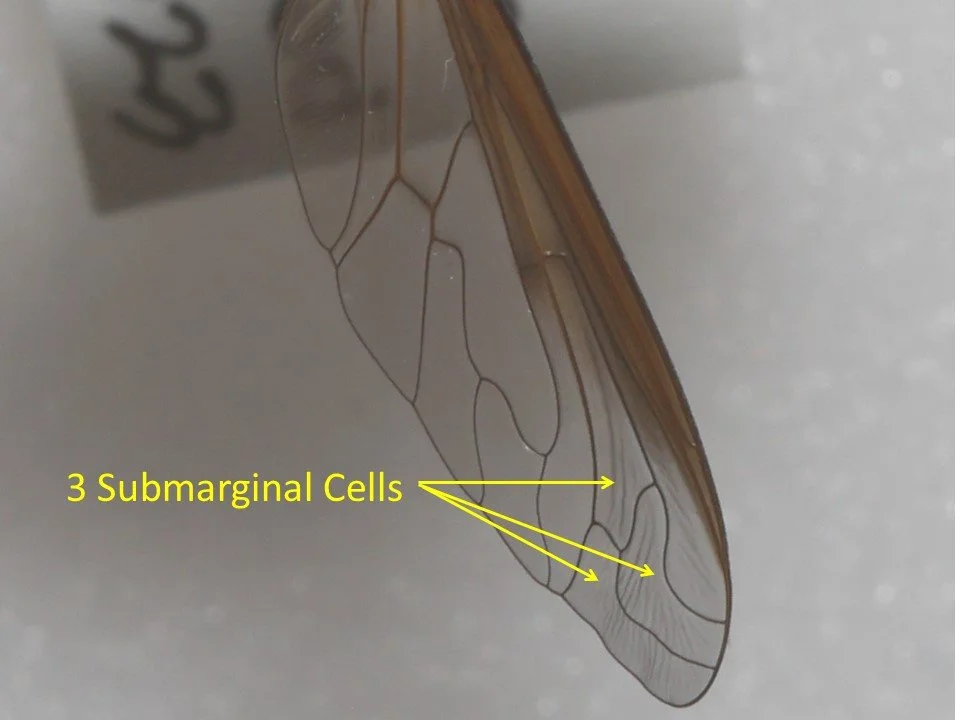
3 Submarginal Cells
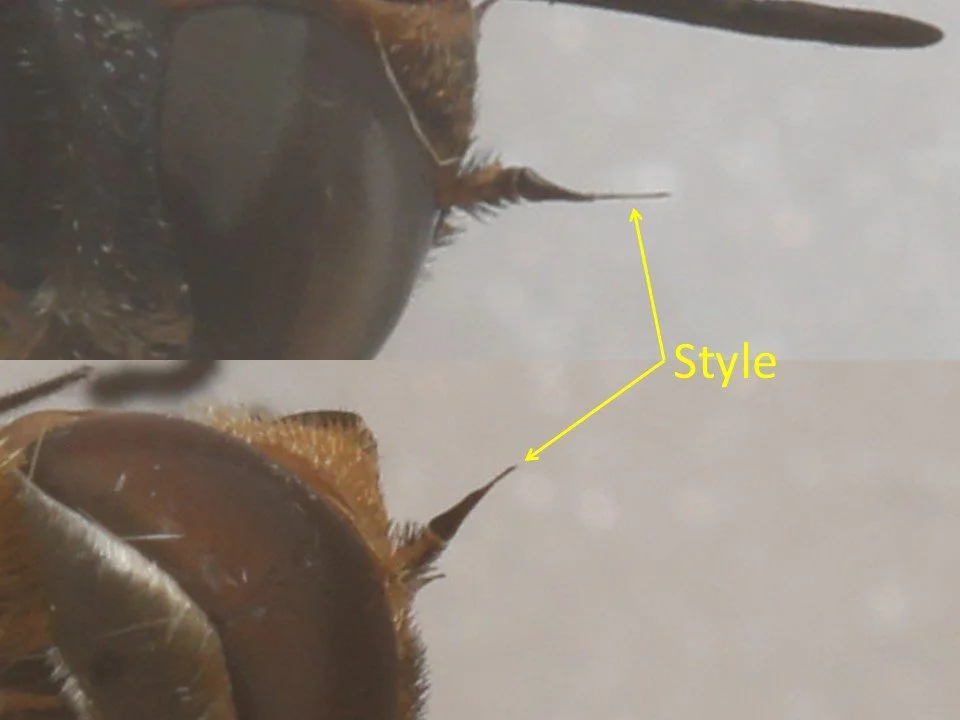
Apical Bristle (Style)
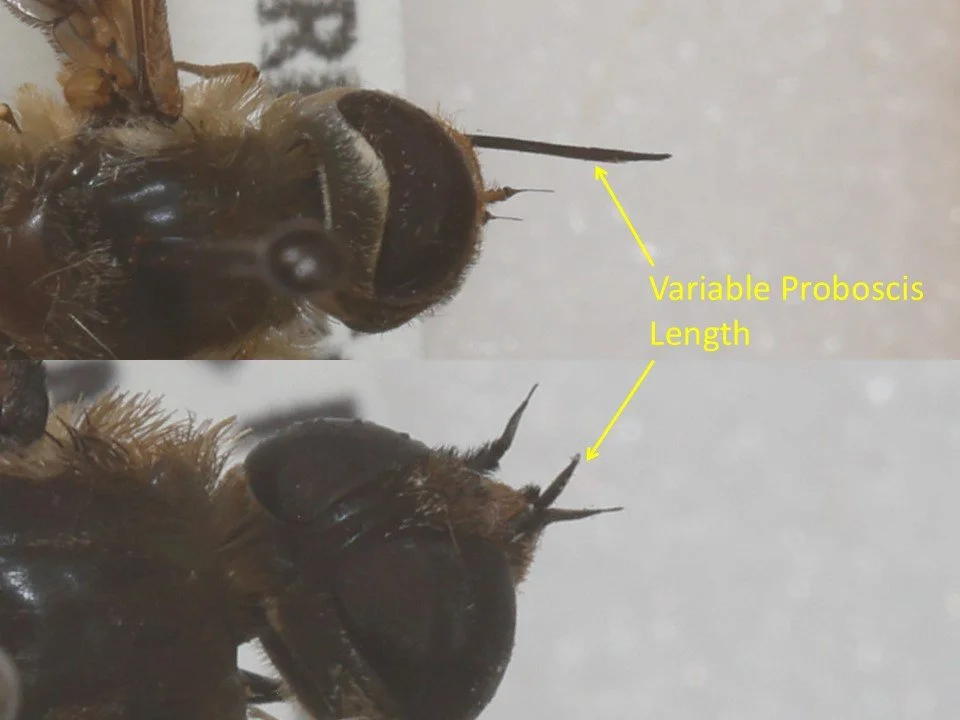
Variable Proboscis Lengths
This genus in the Tribe Villini consists of fairly small to mid-sized adults with wings infuscated to varying degrees. Throughout the genus, the front tibiae are smooth, and the 2nd longitudinal vein arises rectangularly at or very near the anterior crossvein. They are sometimes attracted to walls and cars sitting in the sun. The larvae are parasitic on Hymenoptera and dipterans, notably tachinids.
Varying Infuscation
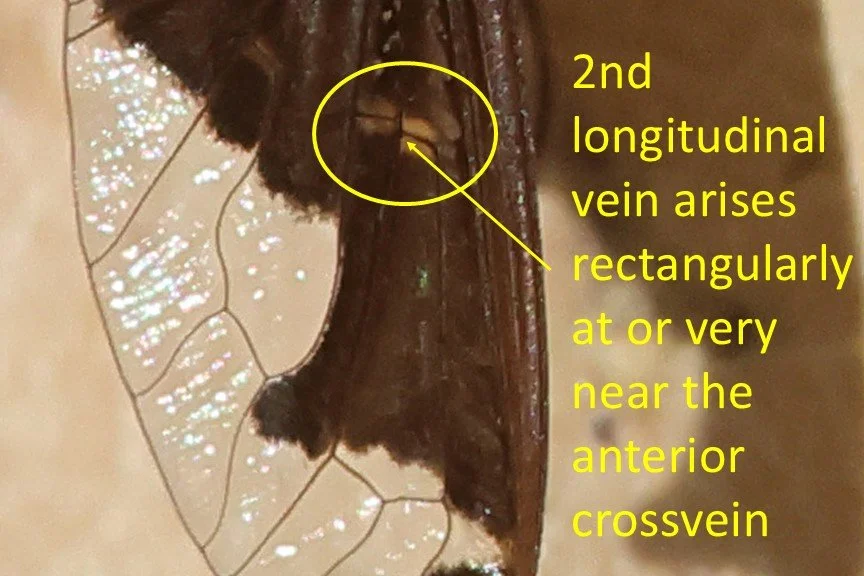
R2+3 at Anterior Crossvein
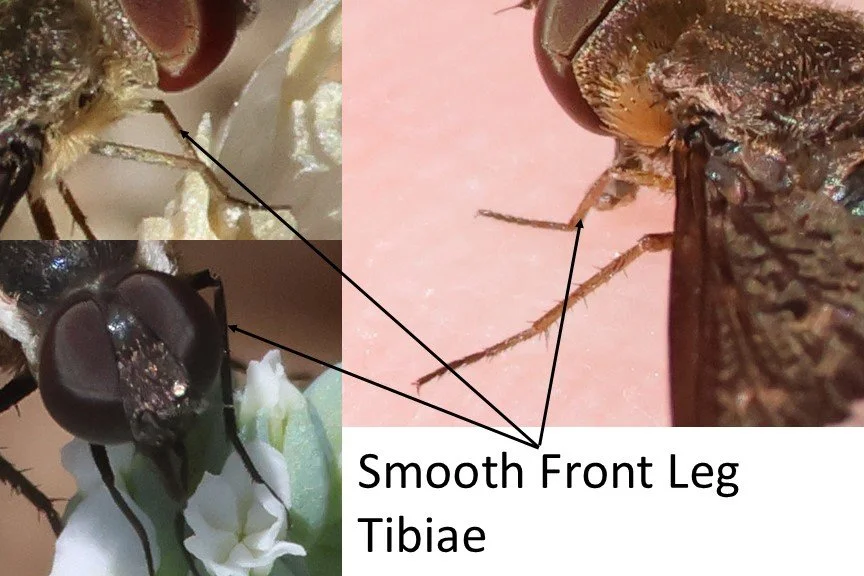
Smooth Front Tibiae
This is a recently described tropical genus with 2 species extending into the U.S. Formerly, its members were included in Hemipenthes but were elevated to their own genus in 2020. They are similar to Hemipenthes, but both Nearctic species of Ins have more color on the abdomen and thorax.
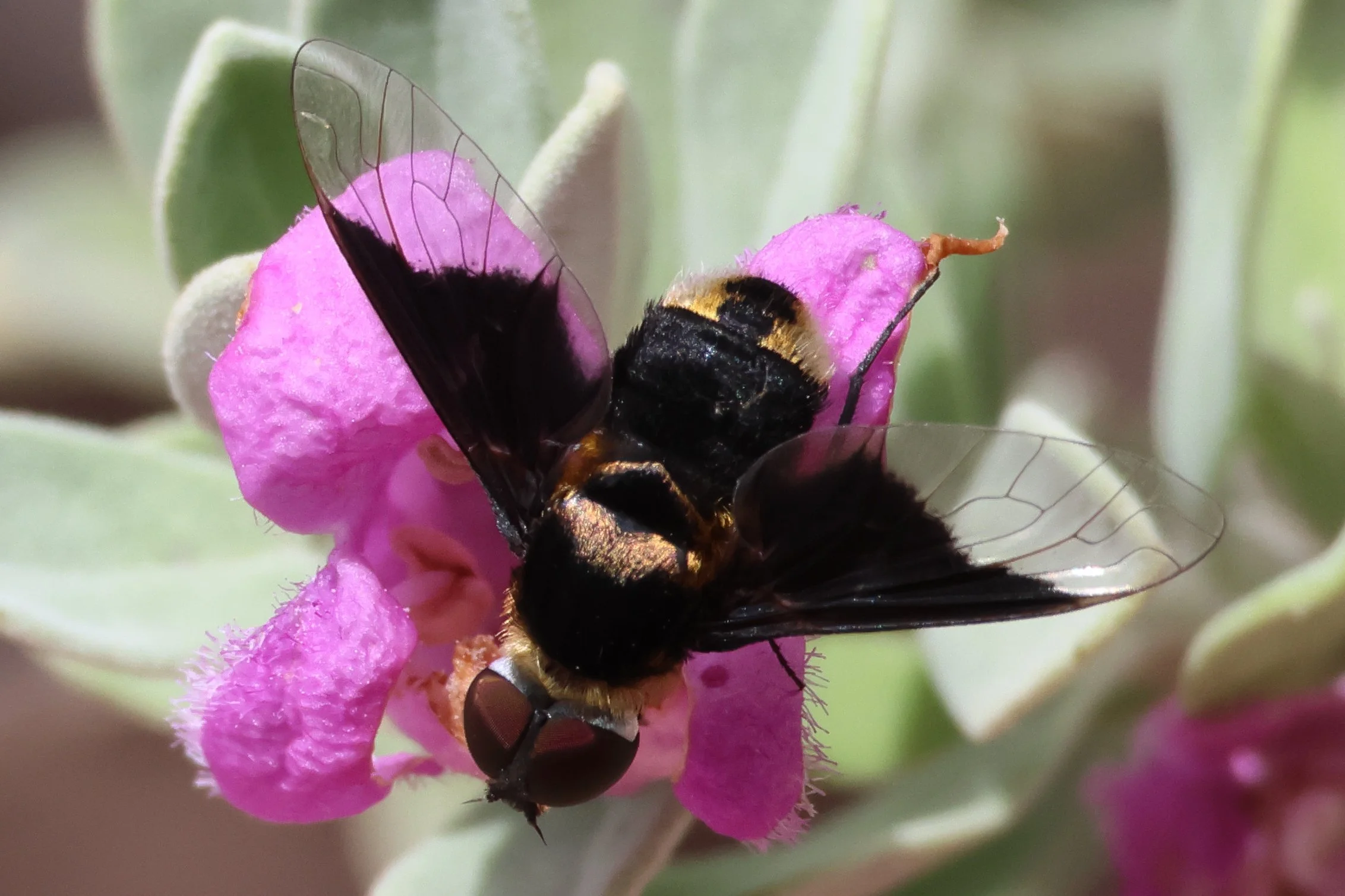
Thorax & Abdomen Color
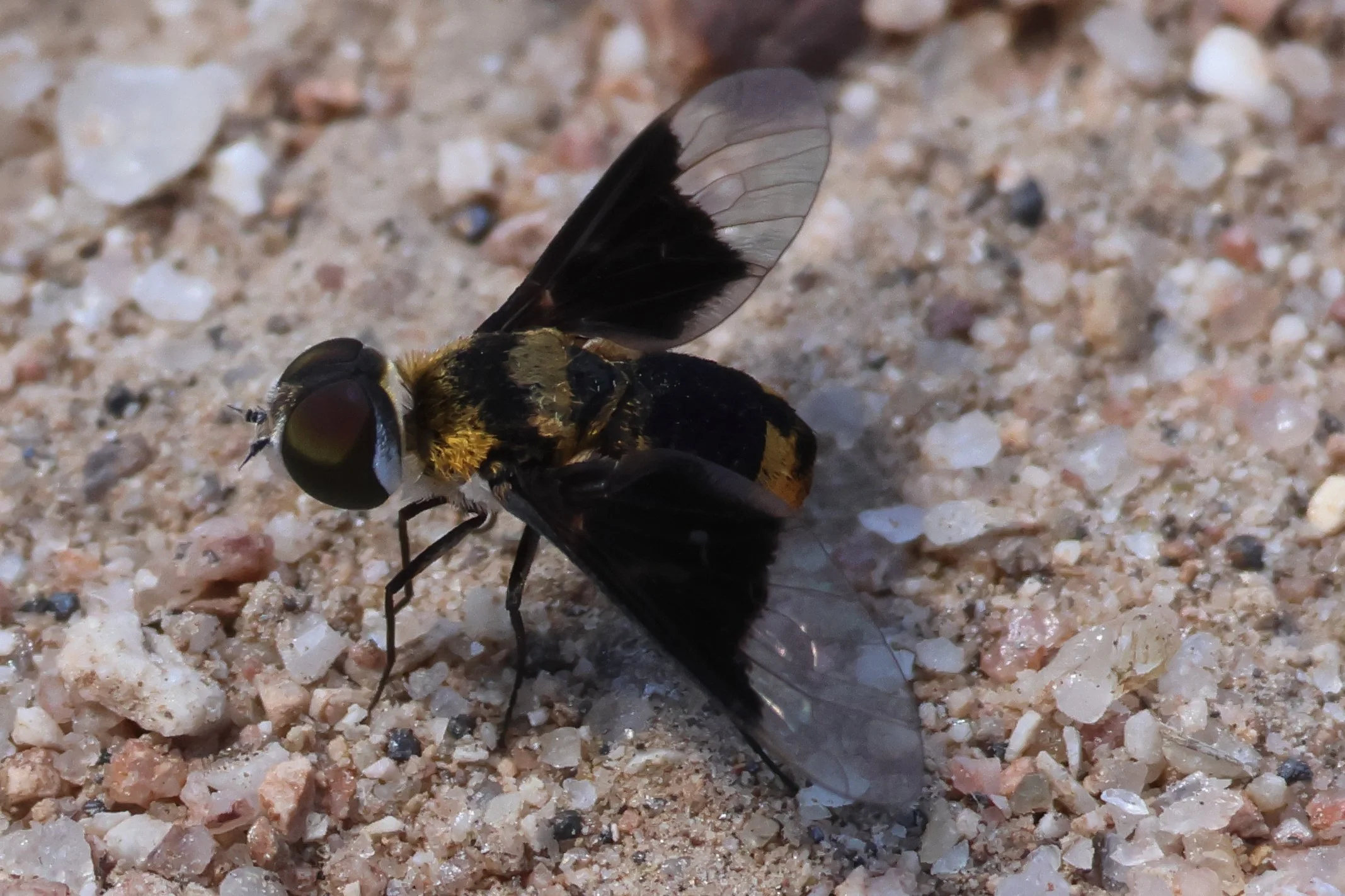
Thorax & Abdomen Color

Thorax & Abdomen Color
Members of this genus are small to medium, typically with a long proboscis. Most possess tufts of lateral pile on the abdomen. Males of a number of species have mirror-like reflective scales, generally in neat dorsal bands on the distal half of the abdomen. Wing patterns range from almost completely hyaline to heavily maculated. Sexing individuals with external characteristics is difficult, as the eyes of males don’t seem to touch in the typical bombyliid fashion. Additionally, females of some species may lack reflective scales. Obtaining attractive, well-exposed photographs of males can be difficult due to the intense reflection from the abdominal scales. Consider a flash bracket to bring your light source off the lens axis. Typically, species have 2 submarginal cells, a character separating them from Stonyx, with three. In all Lepidanthrax, the short third antennal segment, with a long, thin style extending from it, is diagnostic. In the latest major revision of the genus (Hall 1976), 8 subgroups are suggested, 5 of which have been found within Arizona.
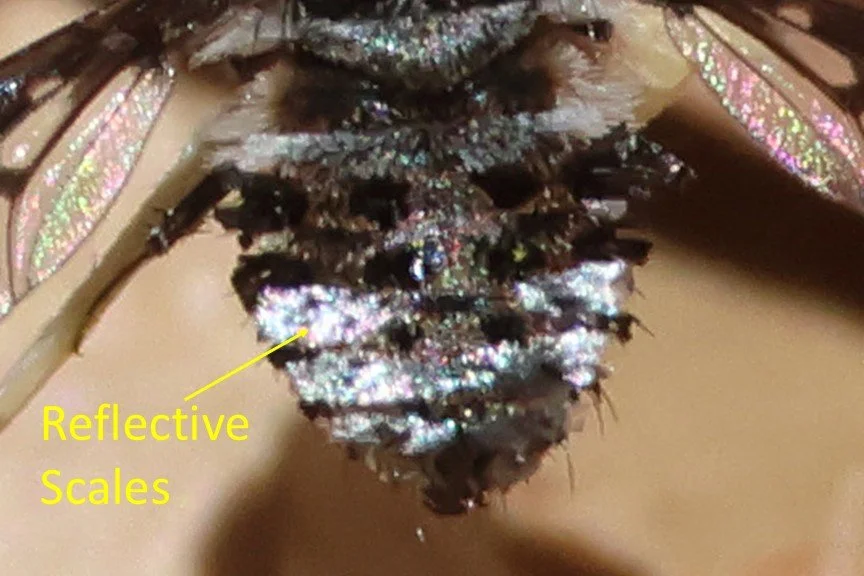
Reflective Scales
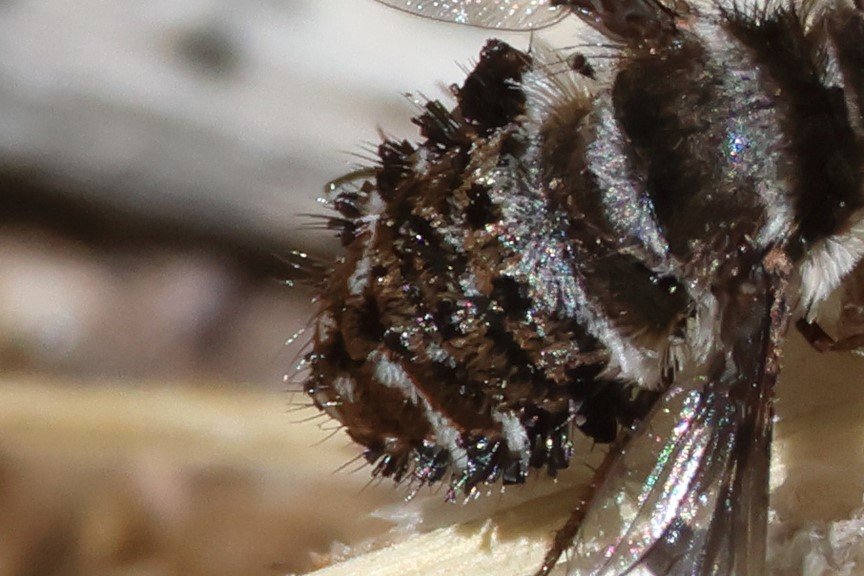
Tufts of Lateral Pile
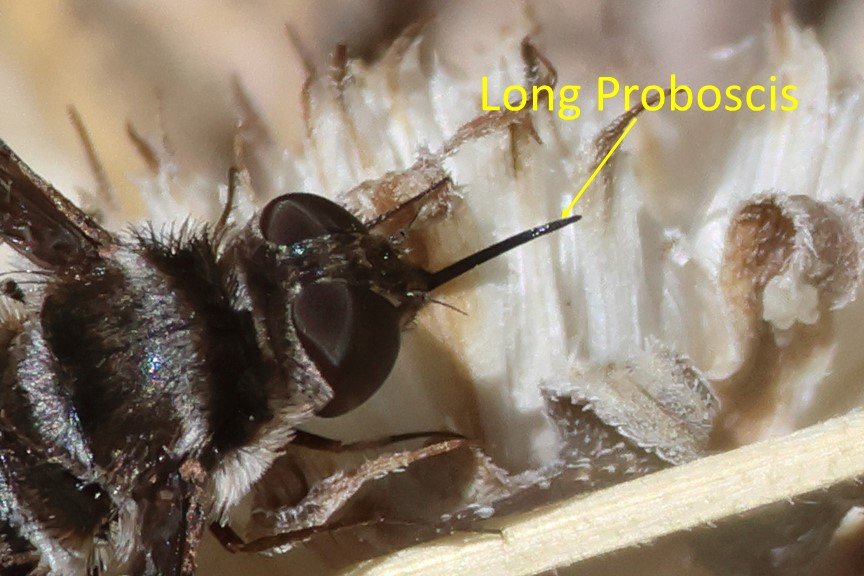
Long Proboscis
This genus includes small to mid-sized species, often with an s-shaped bend near the distal end of vein R2+3. There are varying amounts of pattern in the front half of the wing, depending on the species. Adults perch directly on the ground or on low inflorescences. Discrepancies between taxa are common in the literature and on websites. Species delineation is unclear, but there do seem to be 3 distinct taxa occurring regularly within the region. N. mira perhaps belongs in a genus of its own.
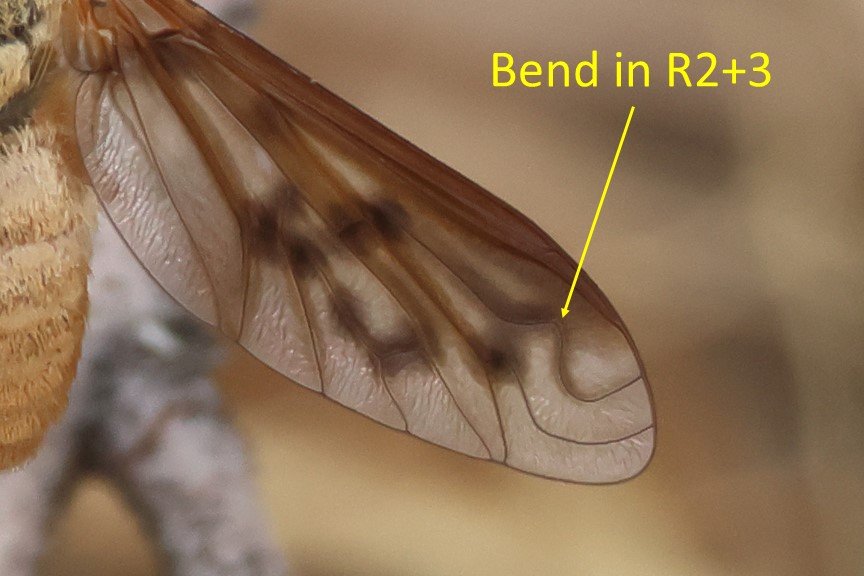
Bend at Distal End of 2nd Longitudinal Vein
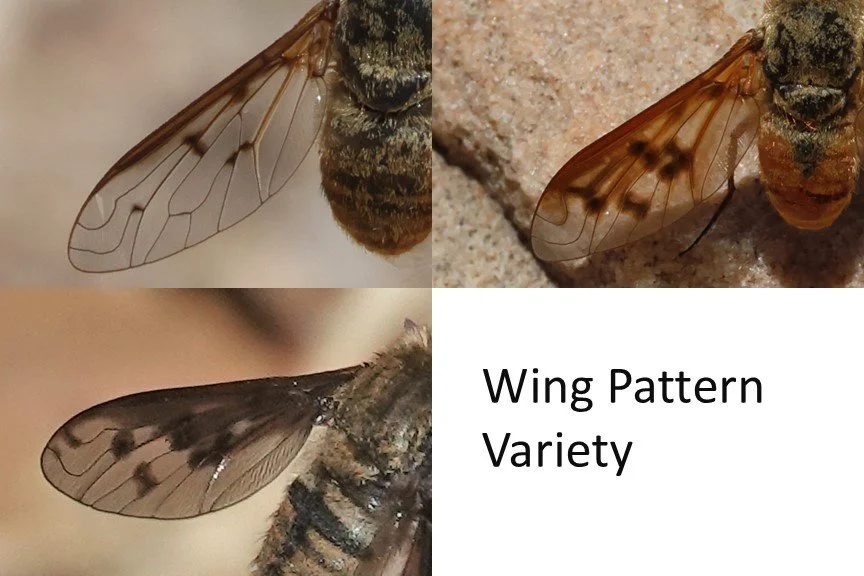
Wing Patterns
These are large flies, quite similar to Exoprosopa but always with 4 or more submarginal cells. Adults tend to perch on the ground. The larvae are hyperparasites of scoliid wasps.
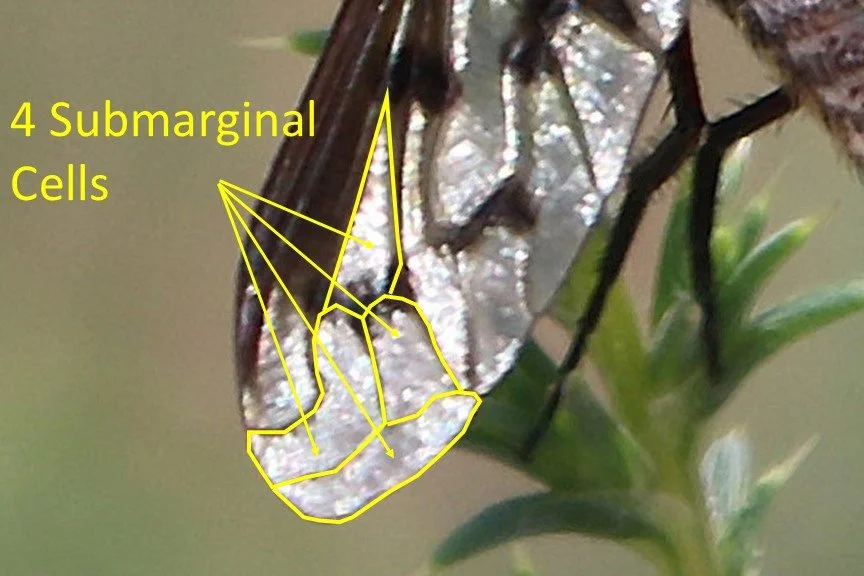
4 or More Submarginal Cells
Members of this genus are small to mid-sized and mostly black. The 2nd longitudinal vein is exceptionally serpentine and the wings are oddly short and wide. Only a single Nearctic species is known.
This genus was formerly a subset of the catch-all genus Villa. Adults are medium-sized with pointed faces and spiny front tibiae. There is often infuscation in the front half of the wings. The genus consists of several dozen species, largely in the western U.S. Adults are avid flower-feeders; the larvae parasitize bembecid wasps. Tribe Villini.
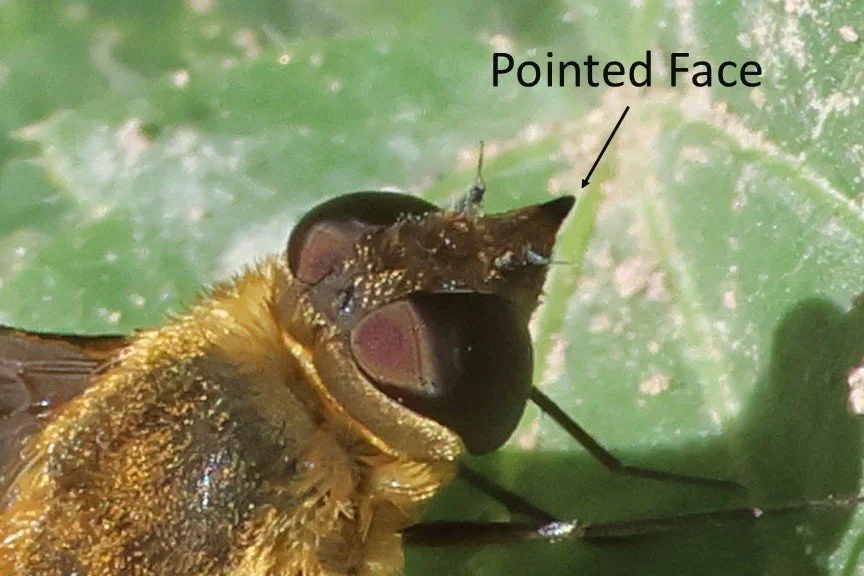
Pointed Face
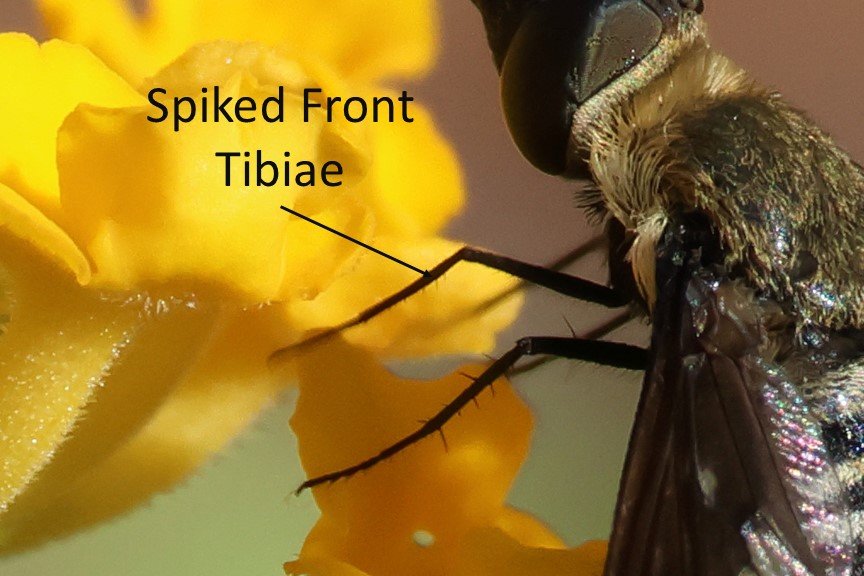
Spiny Front Tibiae
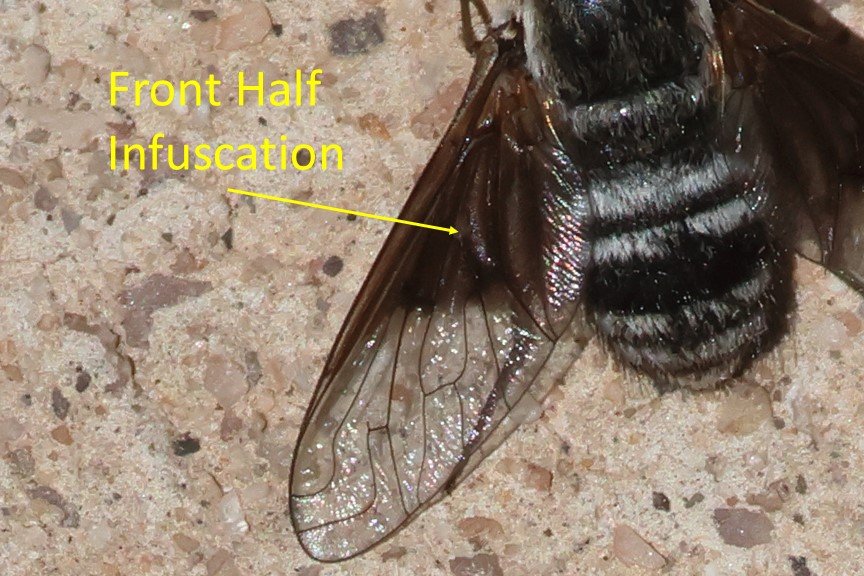
Front Half Wing Infuscation
Most of these large bombyliids have elaborately patterned wings, short antennae and proboscis, and 2 (rarely 3) submarginal cells. Most have an extra stump vein entering the 3rd posterior cell. Adults feed avidly on flowers, especially composites. The larvae are parasitic on caterpillars of various nocturnal lepidoptera. Tribe Villini.
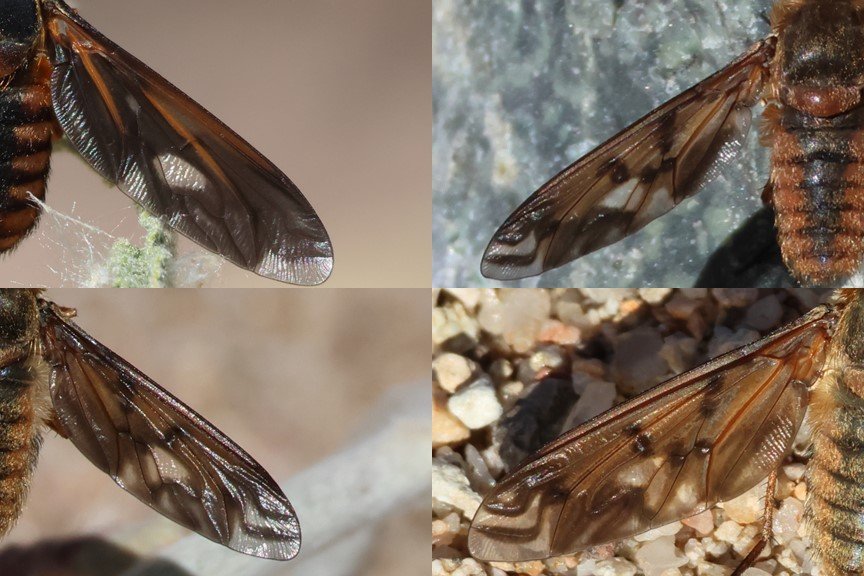
Elaborately Patterned Wings
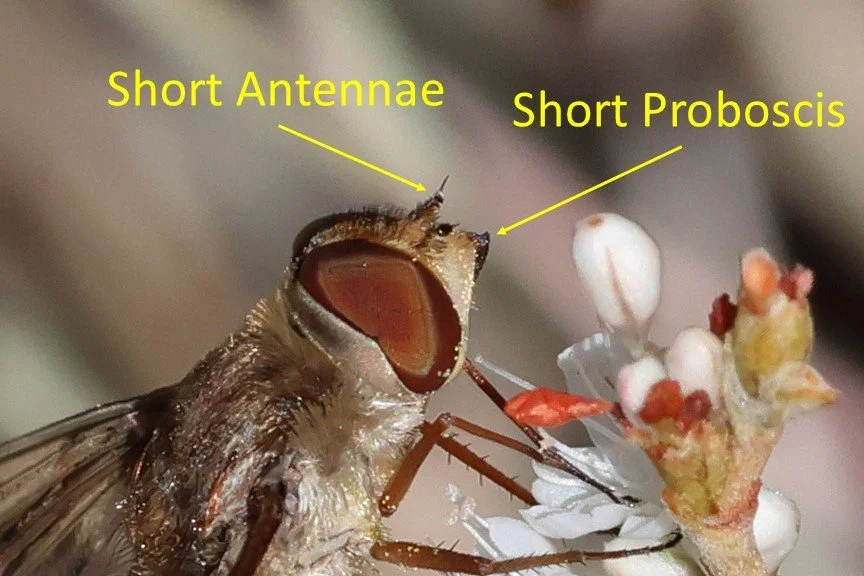
Short Antennae & Proboscis
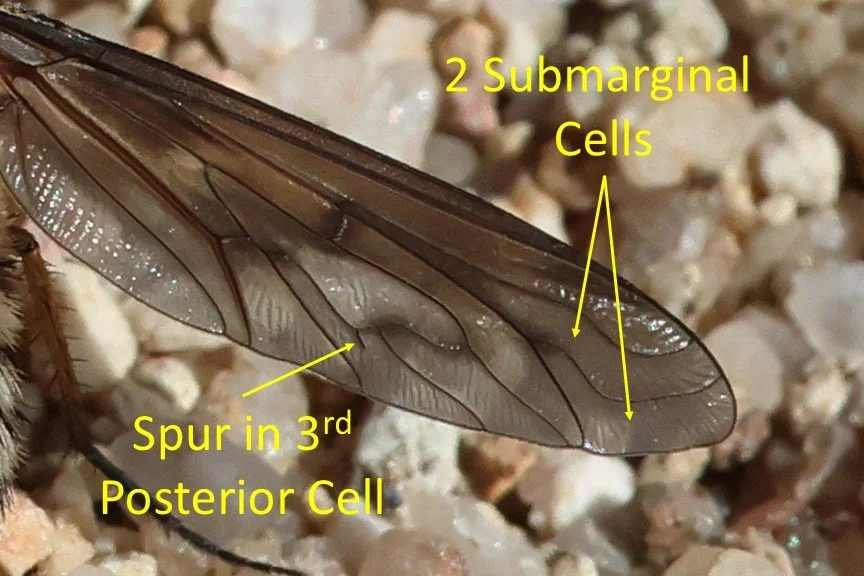
2 Submarginal Cells & Spur Vein in 3rd Posterior Cell
This is a genus of mid-sized species with, importantly, the beak extending past the face. In general, they also have short antennae but with long styles on the 3rd segments. Most species bear diagonal dark wing infuscations. Adults are fond of composites and their larvae parasitize tiphiid wasp immatures.
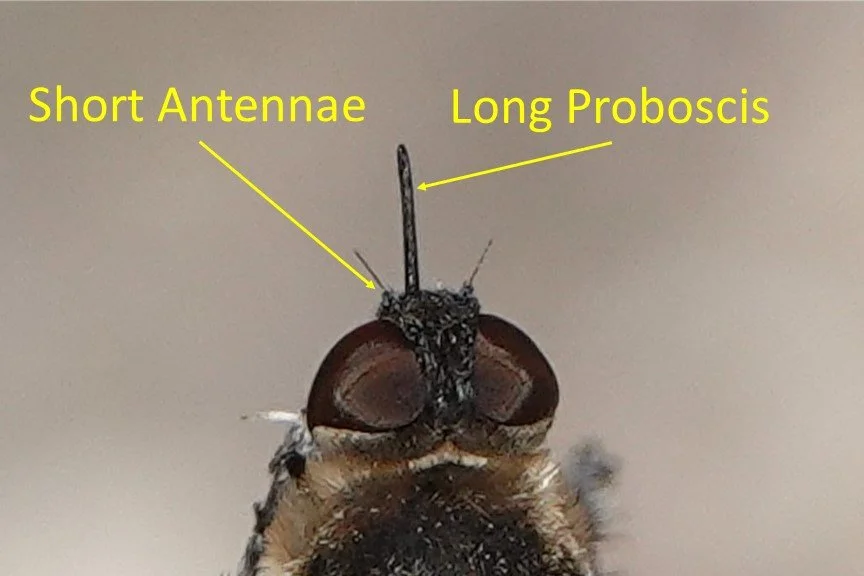
Short Antennae & Long Proboscis
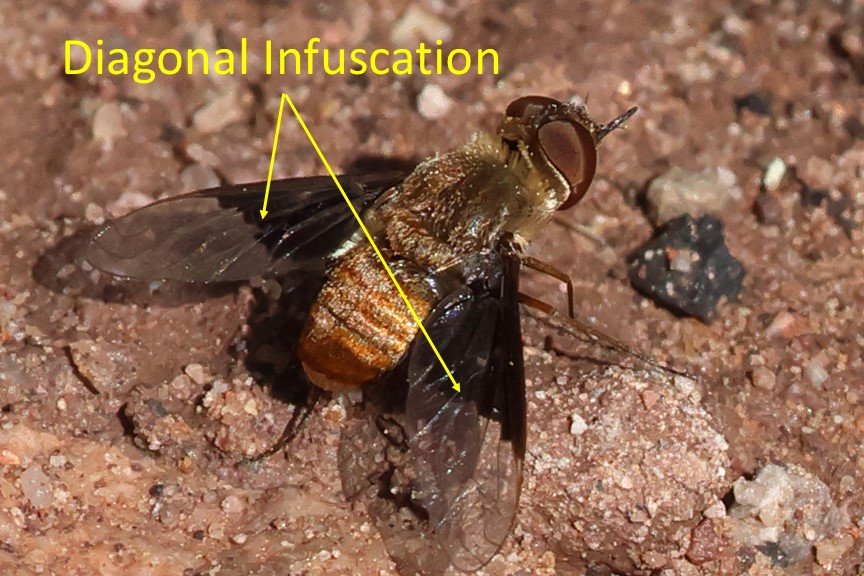
Dark Basal Wing Infuscation
This is a potentially new genus (description in prep) that includes local species with traits of both Lepidanthrax and Chrysanthrax. Its members are small, have a short proboscis, are heavily spotted, and are quite tomentose. The more southern species, “nataliae” flies primarily in late summer; the more northern species, “devichei” is a spring flier.
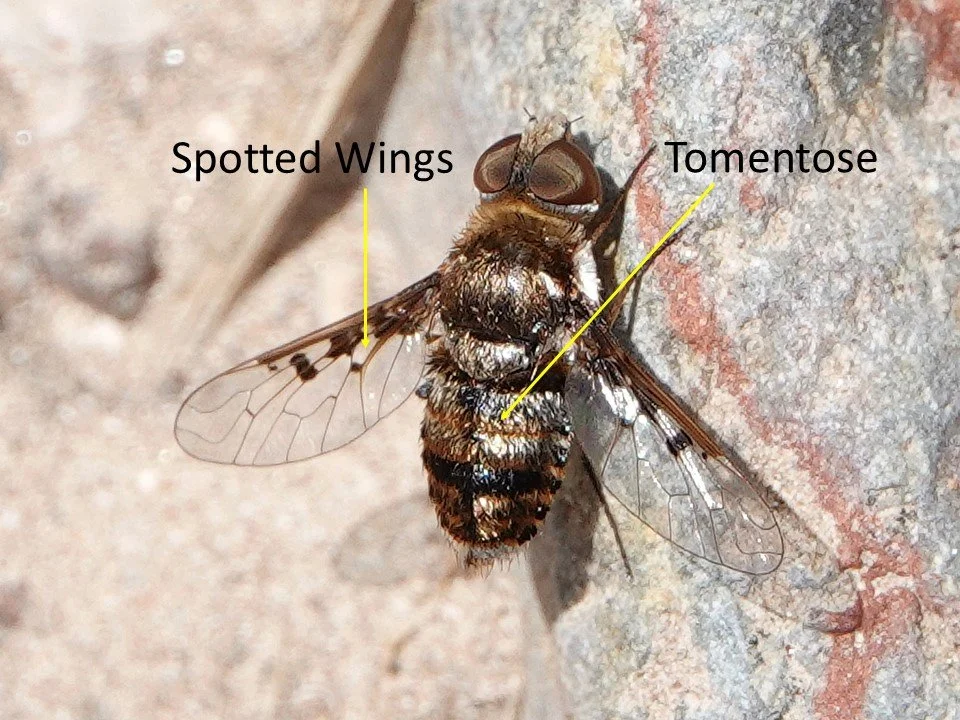
Spotted Wings & Quite Tomentose
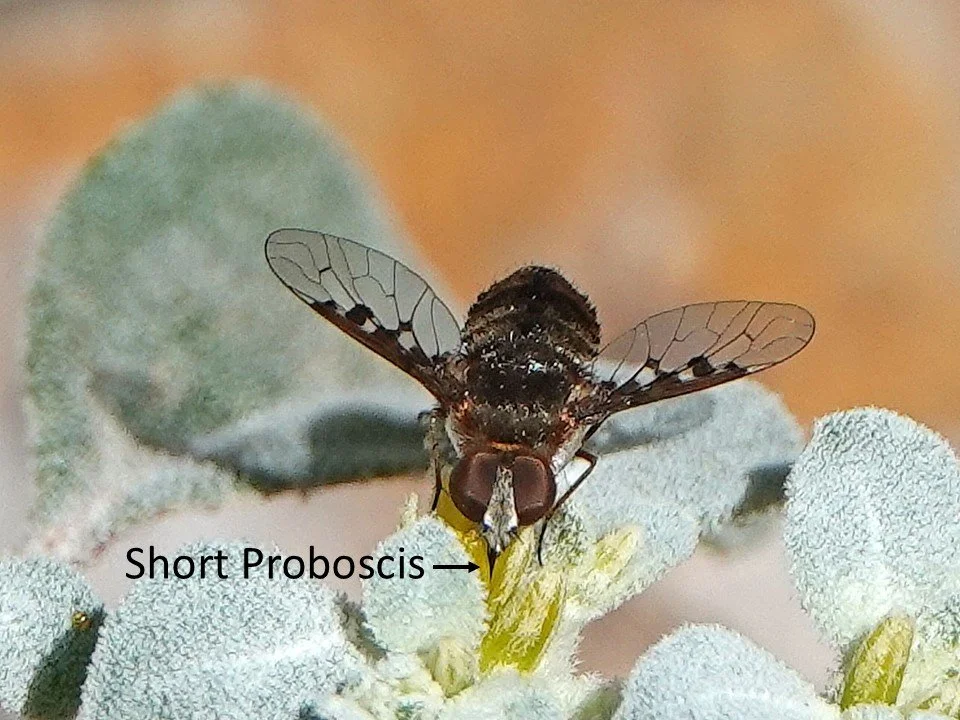
Short Proboscis
This is a small genus of distinctive, mid-sized, highly patterned species with a fairly long proboscis, 3 submarginal cells, and a long style on the 3rd antennal segment. Adults perch on the ground and visit composites. It is apparently closely related to Lepidanthrax. Tribe Villini.
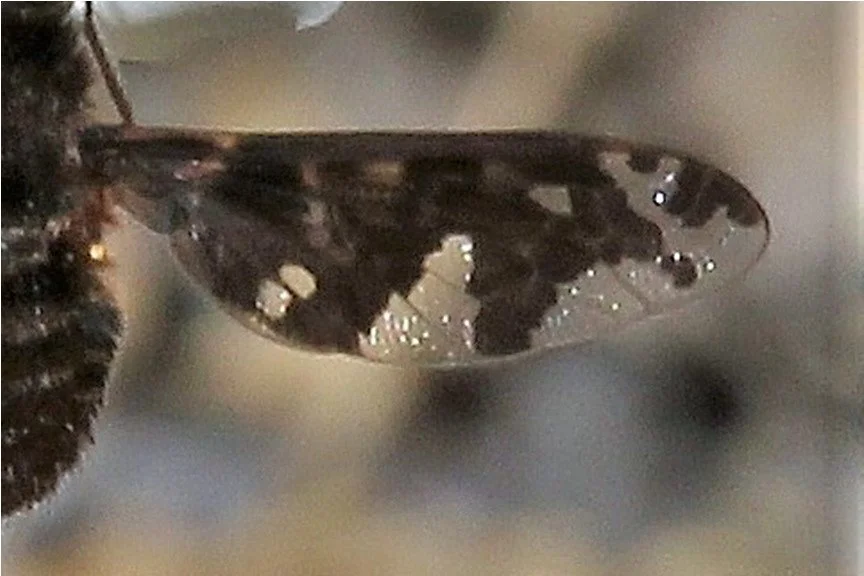
Patterned Wings
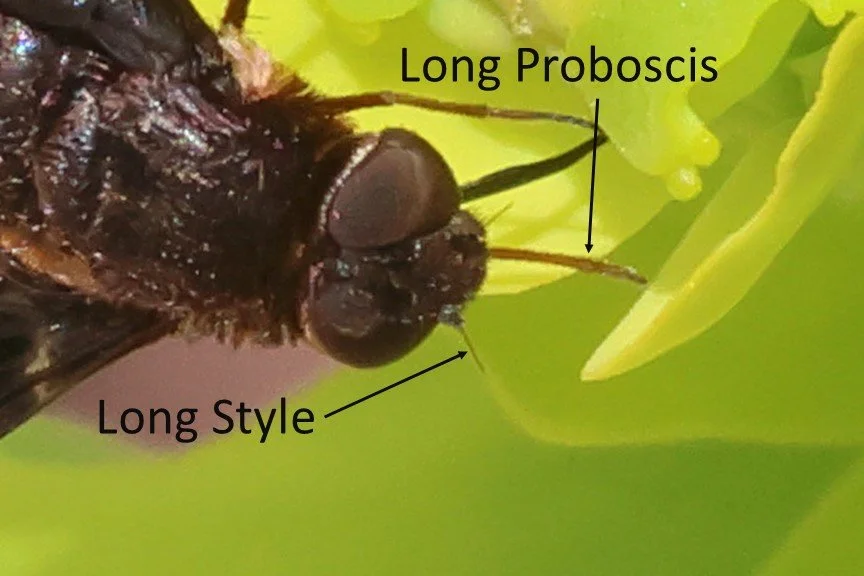
Long Style on 3rd Antennal Segment & Long Proboscis
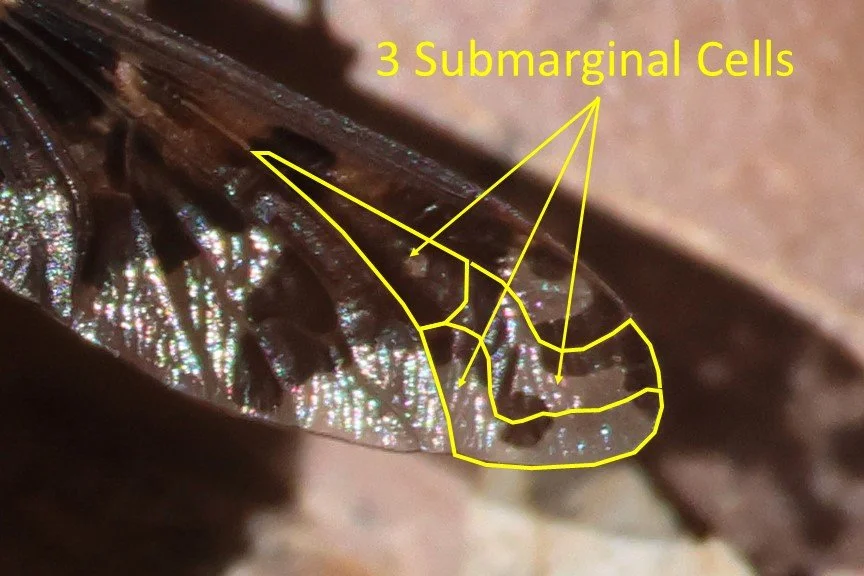
3 Submarginal Cells
This is an interesting genus of mid-sized species, typically with wings windowed at the crossveins (McAlpine et al 1981) and often a mid-dorsal gap in the bands of pale white tomentum on abdominal segments T3 and T4. They have an affinity for low-growing flowers and regularly perch on the ground. The larvae parasitize muscoid flies and locusts (grasshoppers). Tribe Villini.
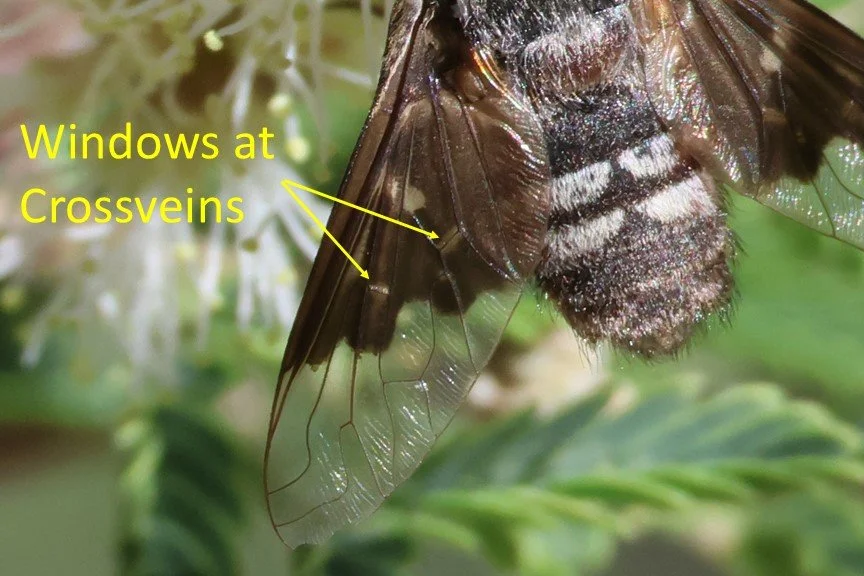
Wing Windowed at Crossveins
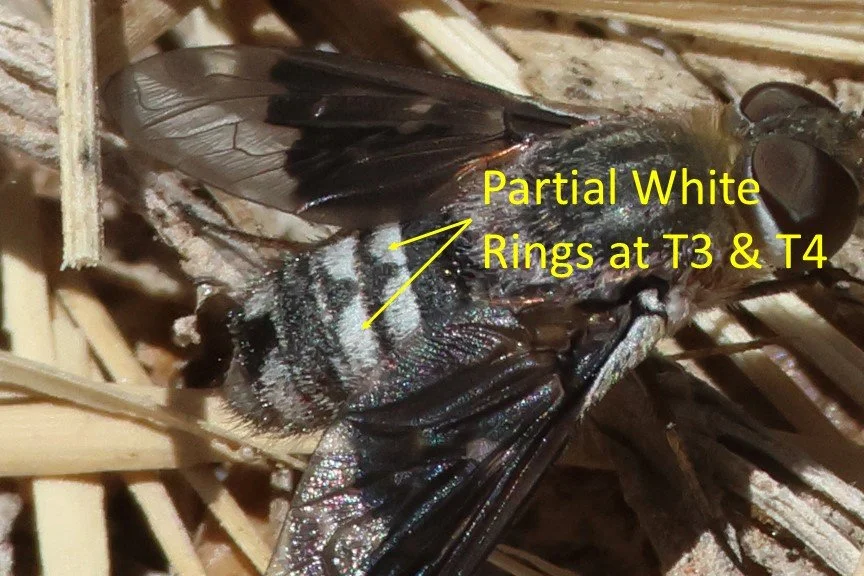
Mid-dorsal Gap in Bands of Pale White Tomentum on T3 & T4
This is a phenotypically rich genus, one of 16 or more genera lumped into the tribe Villini. Identification is often difficult, largely due to a paucity of material permitting identification at the species level. Adults typically have a non-protruding proboscis, hyaline wings, a rounded face and prominent costal combs. There is a huge variety of thoracic and abdominal markings. Some are lushly covered in pile and/or tomentum, some nearly lack adornment, some are very large, and some are 5 mm or smaller. Websites such as BugGuide and INaturalist are of little help since their identifications generally do not extend below the genus level. There have been few if any thorough treatments, and comprehensive keys are non-existent. They will be a great challenge for future researchers. Although not a common trait in bombyliids, they occasionally walk, e.g., at puddle edges. Their larvae are parasitic on nocturnal lepidoptera and tenebrionid beetles. The following 5 taxa seem to be identifiable, but each may represent more than one species.
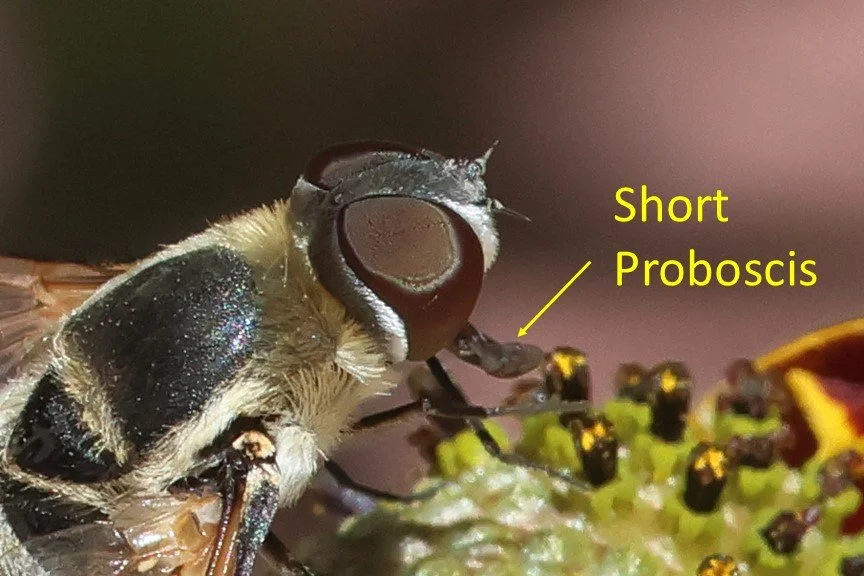
Short Proboscis
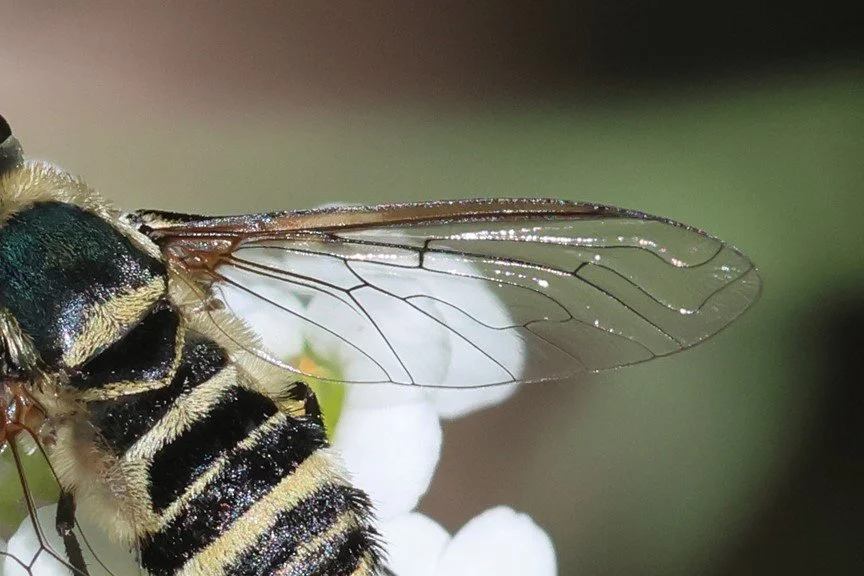
Hyaline Wings
This genus, formerly a subgroup of the genus Anthrax, consists of a handful of very large species, with an abdominal length of 12-17 mm. The 3rd posterior cell is subdivided by an extra crossvein, a trait not present in Anthrax. They are not known to take nectar but occasionally go to water. Their antennae do not appear to be feathered. Often they perch vertically, occasionally on people (try to not flinch). Tribe Anthracini.
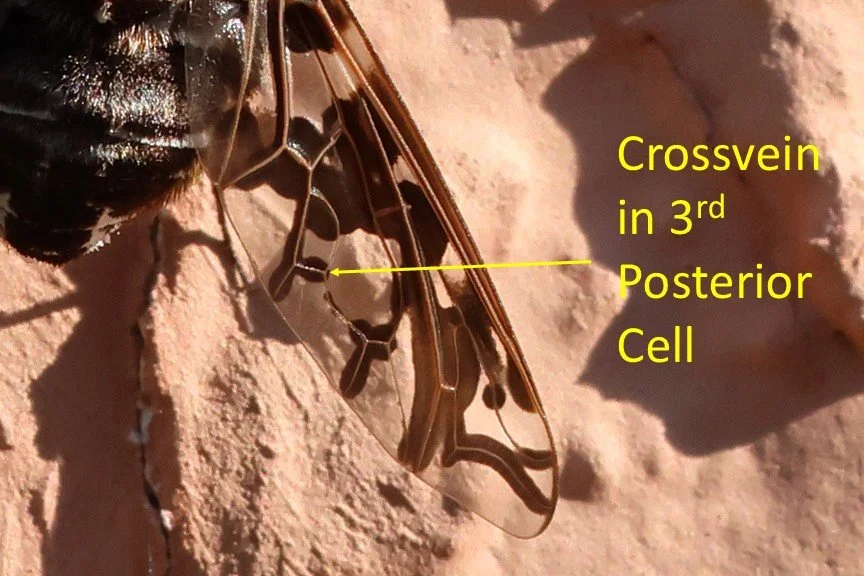
3rd Posterior Cell Crossvein
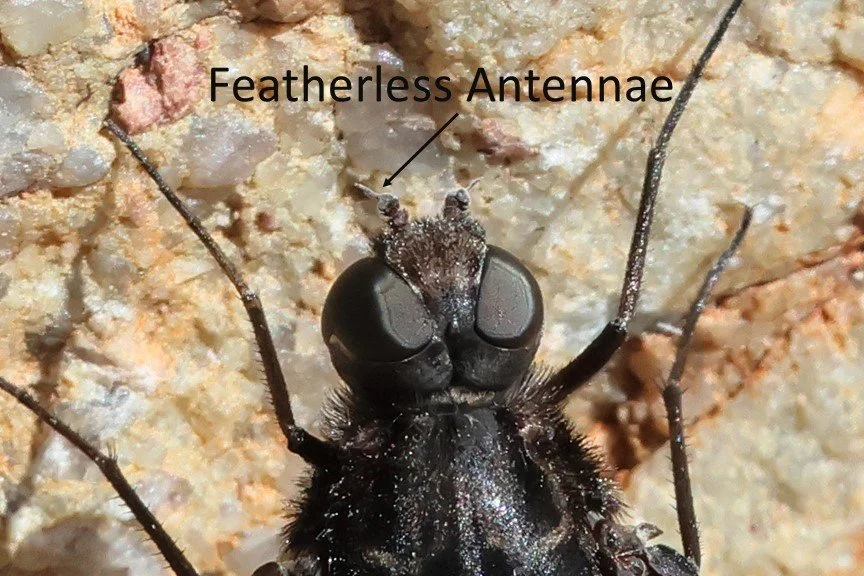
Antennae Not Feathered