
Genus Chrysanthrax
Chrysanthrax adumbratus
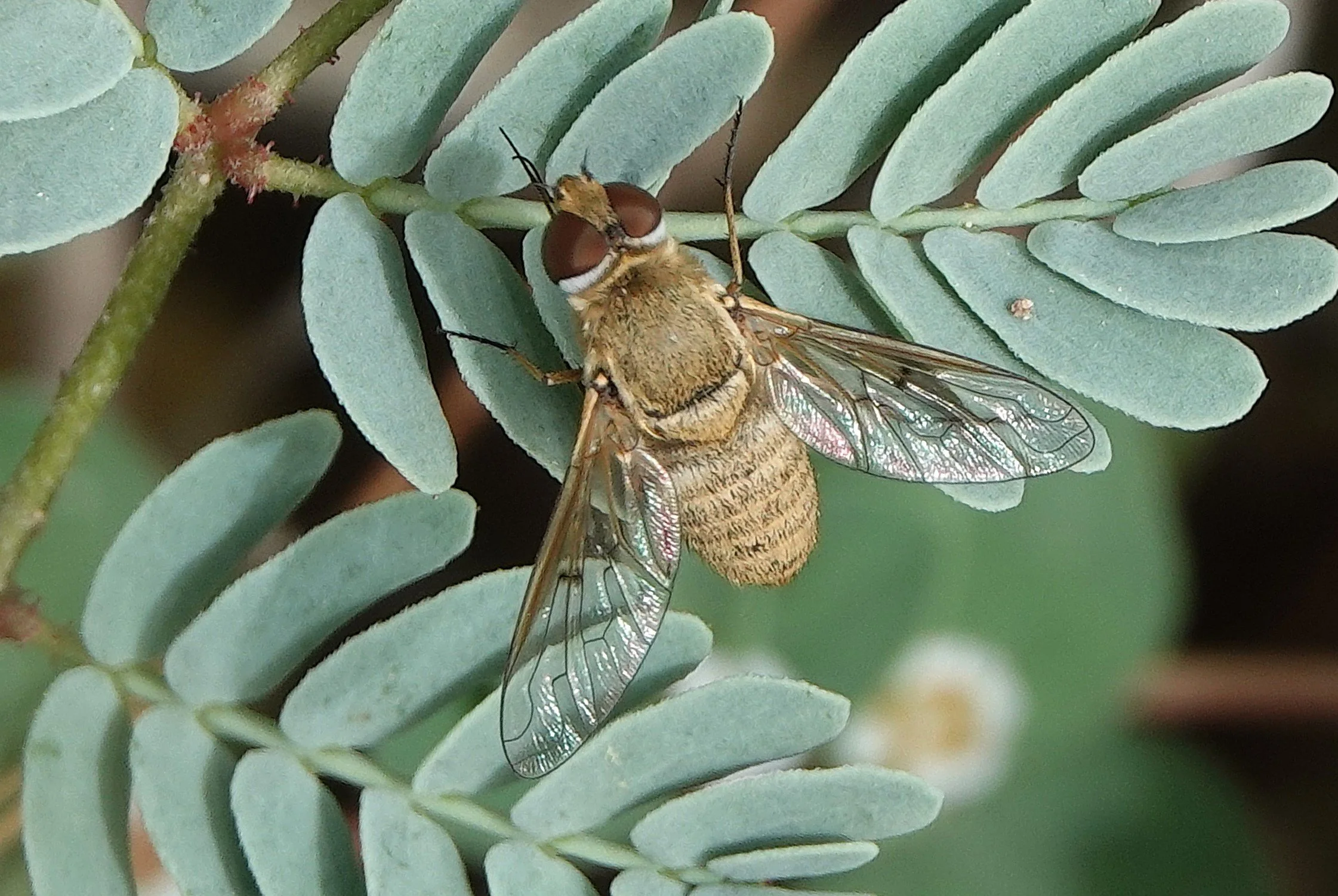
A relatively unknown taxon but specimens at the Smithsonian Museum match well with older descriptions. The species has an immaculate tan abdomen, few markings on the thorax, and a light brown wing pattern. It is arguably most similar to eudorus but lacks the white thoracic border and pronounced abdominal rings, and has similar but paler spotting on the wings.
Range: COCH, PIMA, STCR
Occurs: Late July to Mid-August
Chrysanthrax arenosus

This brilliant little spot of color has a bright red-orange body occasionally with a pale mid-line pattern. The 50/50 wing pattern is infuscated with orange and lacks any dark spotting. It may fly within the shrubbery and is not often seen in numbers.
Range: COCH, GRAH, GREE, PIMA, STCR
Occurs: Mid-April to Late May
Chrysanthrax arizonensis
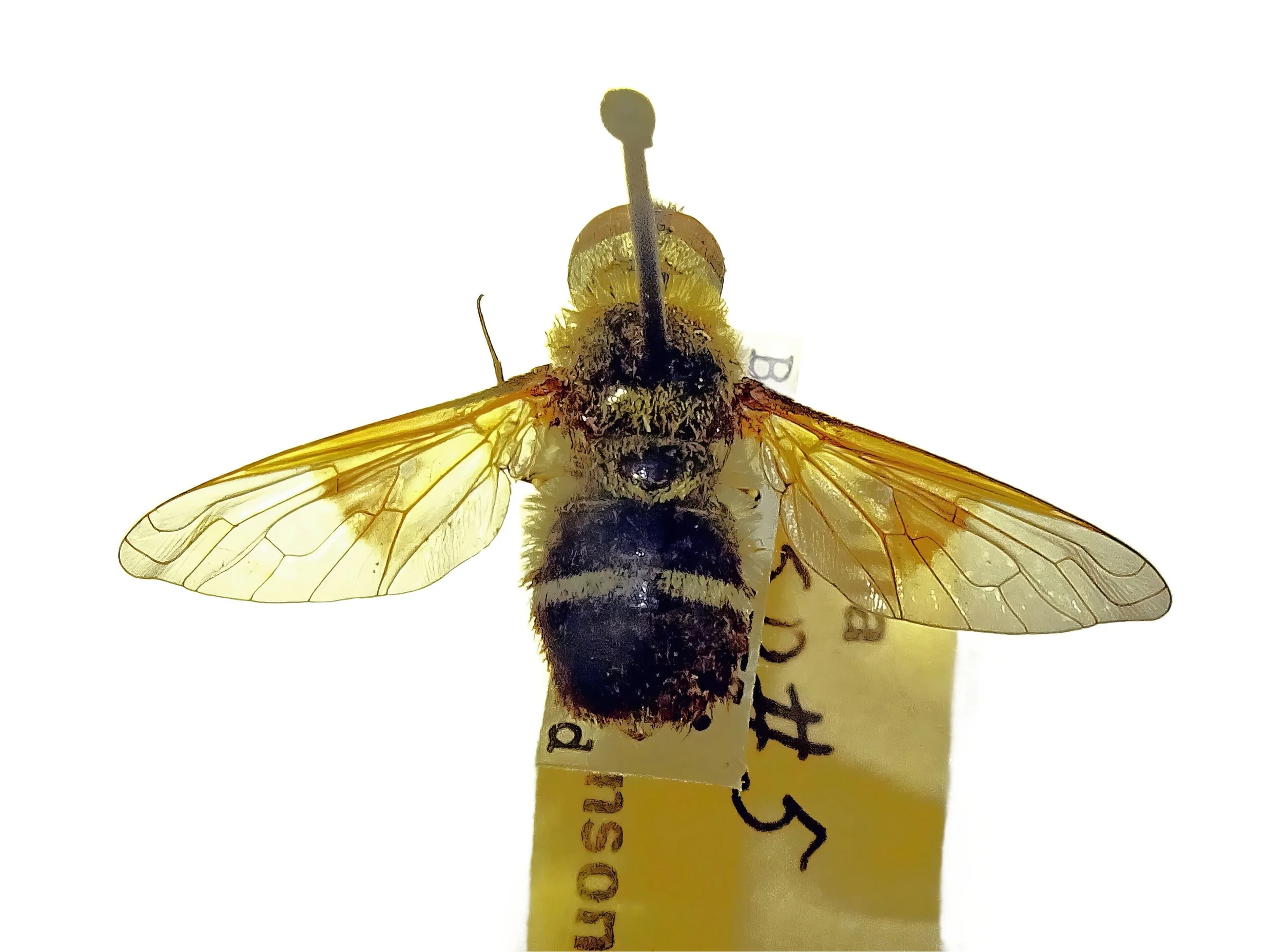
This Chrysanthrax is one of the few that lack any gold coloration. Although very uncommon, occasional specimens of this taxon turn up in warmer weather. Note the pale gray on the thorax, the first few tergites, and the last few tergites. Only the legs and middle abdominal segments are black. Although the wings are hyaline, there is also some basal orange color to them.
Range: COCH
Occurs: Mid-July, Late September
Chrysanthrax cautor

This is a unique, small to mid-size member of the genus, having about a 40% black infuscation. Most of the thorax and abdomen are covered in brown, orange, and tan tomentum. But most unusual is the presence on the wings of two pronounced black dots, one at the bend of R4 and the other at the base of the 2nd posterior cell.
Range: COCH, STCR
Occurs: Late September to Mid-October
Chrysanthrax cypris
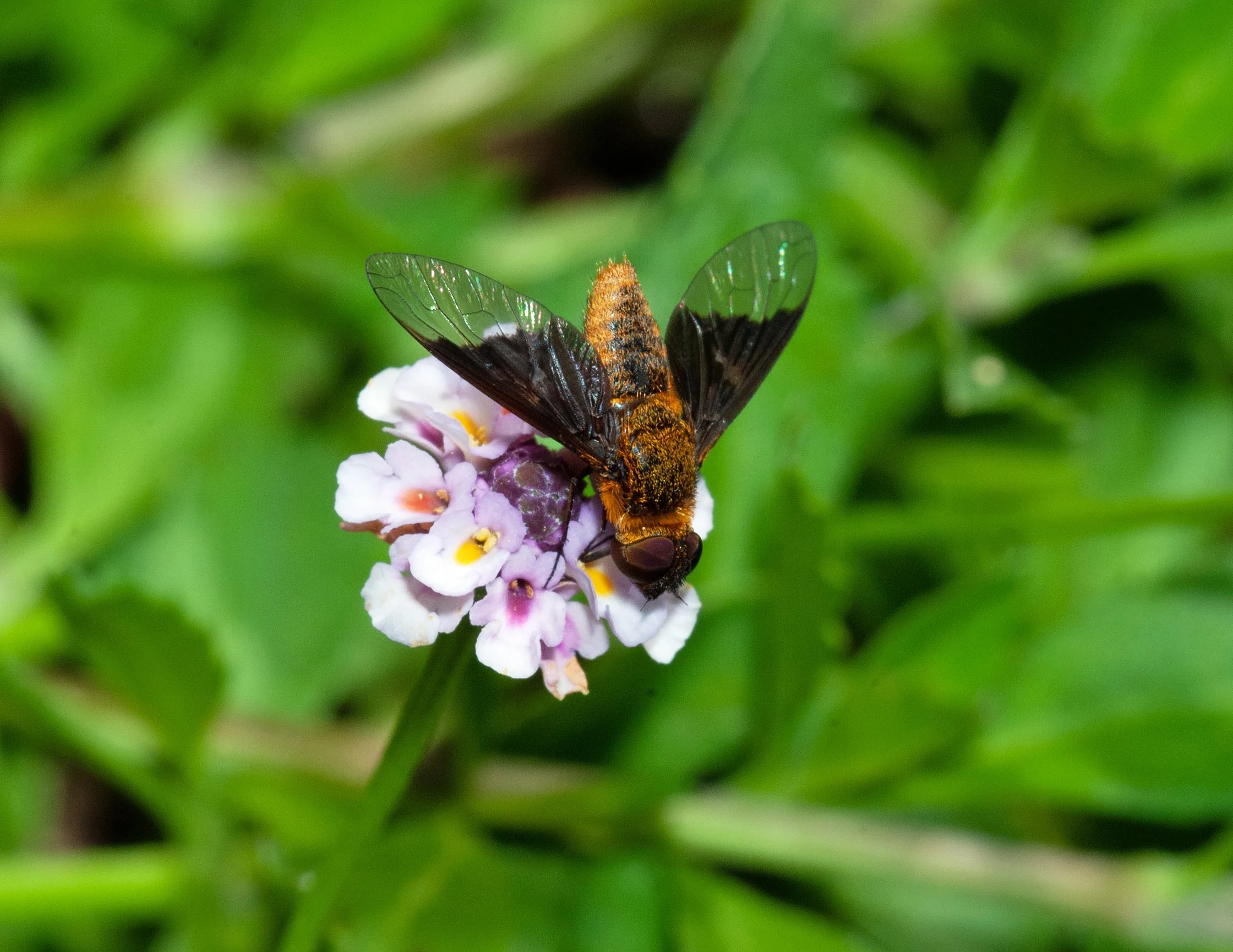
This is primarily an insect of the eastern U.S., nevertheless, it has been reported from our region, most often on the east flank of the Huachucas. It has a pattern similar to that of Rhynchanthrax texana, and were it not for the longer proboscis in texana, the two could easily be confused. Note the variability in the extent of orange coloration on the abdomen. Also diagnostic is the orange 1st segment of the antennae.
Range: COCH, STCR
Occurs: Late July to Early September
Chrysanthrax dispar

Note the dark costal and subcostal areas, as well as the dark dots on the wings. On this quite common and widespread species, the abdomen is always banded but occasionally dark on light rather than light on dark.
Range: COCH, GRAH, GREE, PIMA, PNAL, STCR
Occurs: Early May to Early October
Chrysanthrax “doblado”
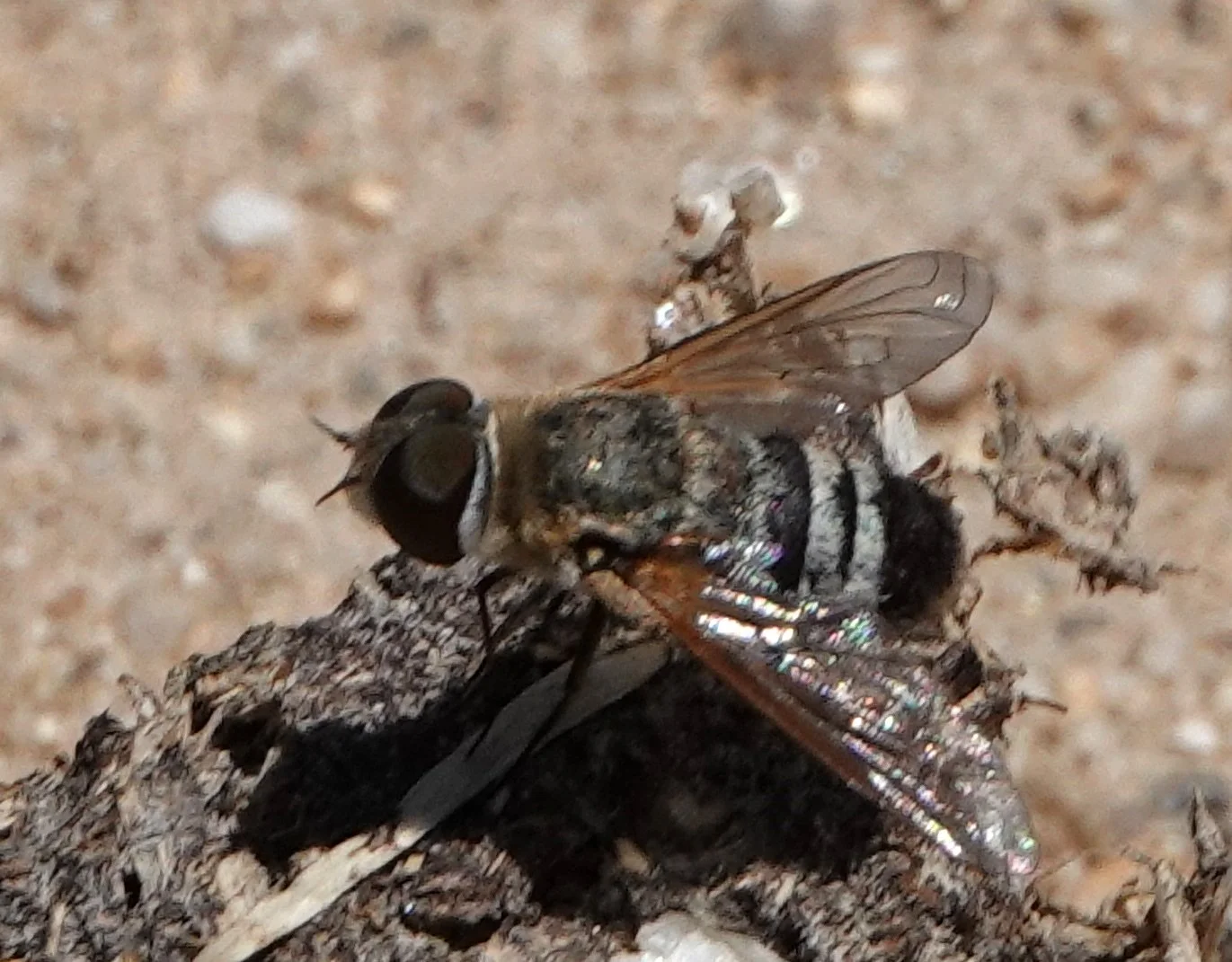
Perhaps undescribed, and therefore to be called doblado (description in prep). A medium-sized member of the genus, this species flies during some of the hottest parts of the year, a behavior that may explain its scarcity in collections. The wings are almost entirely hyaline, i.e., without spotting or infuscation, but with an orange costa and subcosta. There are two prominent, sometimes broken white bands on T3 and T4; most of T1 and T7 are also white. T2 is wide and black, and the 5th segment is black both dorsally and ventrally. Ventral pile is mostly white, and there are lateral tufts of black pile on the abdomen. The facial tomentum is light gray, and the frontal tomentum is orange. The face is only slightly pointed. The first 2 antennal segments are orange. The 3rd antennal segment is long and triangular. Postalar spines are orange and scutellar spines are black. Almost all records for this species are from flowers or beneath the shrubs of graythorn.
Range: COCH, GRAH, PIMA, PNAL
Occurs: Late May to Early July
Chrysanthrax edititius

Although its size is quite variable, this insect has a consistently golden body. The wings show a 50/50 golden infuscation but also additional isolated darker spots at the edge of the infuscation. It is widespread, and commonly nectars at blossoms of Trailing windmills (Allionia).
Range: COCH, GRAH, PIMA, PNAL, STCR
Occurs: Late July to Early October
Chrysanthrax inculta
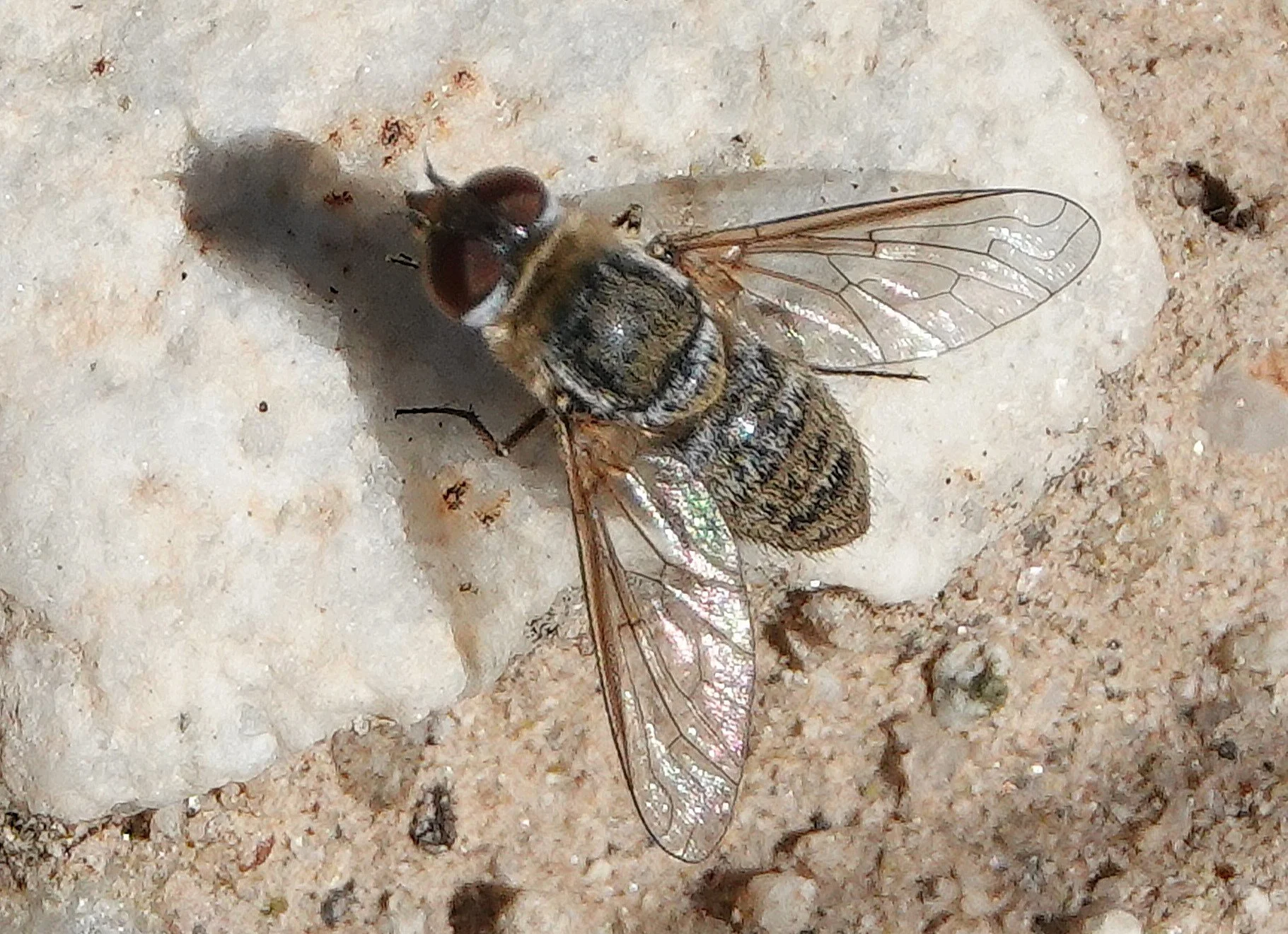
This is a species very much like C. juncturus, below, but with the wings almost totally hyaline. It is provisionally placed here in Chrysanthrax but the specimens in the Smithsonian Museum are included in the genus Villa, where it may rightfully belong. Most of the few known specimens are from just north of Tucson.
Range: PIMA
Occurs: Mid-April to Late April
Chrysanthrax eudorus

Although widely variable in size, this species’ light brown wing pattern remains quite constant. Cells at the costa and subcosta are brown and there are several darkened crossveins just posterior to those major veins. The abdomen is lightly banded with several muted shades of pile. Another character that may be useful is the white "box" formed by narrow lines surrounding the thorax. The species regularly flies within the subcanopy of shrubs and is not easily seen.
Range: COCH, GRAH, GREE, PIMA, PNAL, STCR
Occurs: Early August to Early October
Chrysanthrax junctura

This fairly small species is widespread but never abundant. It is largely tan and there is typically a tan smudge in the middle of the wing surrounded by hyaline areas. It is not commonly seen at nectar.
Range: COCH, GRAH, PIMA, PNAL, STCR
Occurs: Early April to Late September
Chrysanthrax supinus

This is a fairly small species, not well known, but quite distinctive. It is common northward in the state but has been found irregularly south almost to the Mexican border. The bold white and dark markings on the venter are noteworthy. Dorsally, T2 is covered with a skirt of white pile (sometimes edging onto both T1 and T3) and the remainder of the abdomen is dark reddish. Note also the mostly white face and pale orange front.
Range: COCH, GREE, PIMA, PNAL, STCR
Occurs: Mid-April to Late May
Chrysanthrax “xanthoptera”
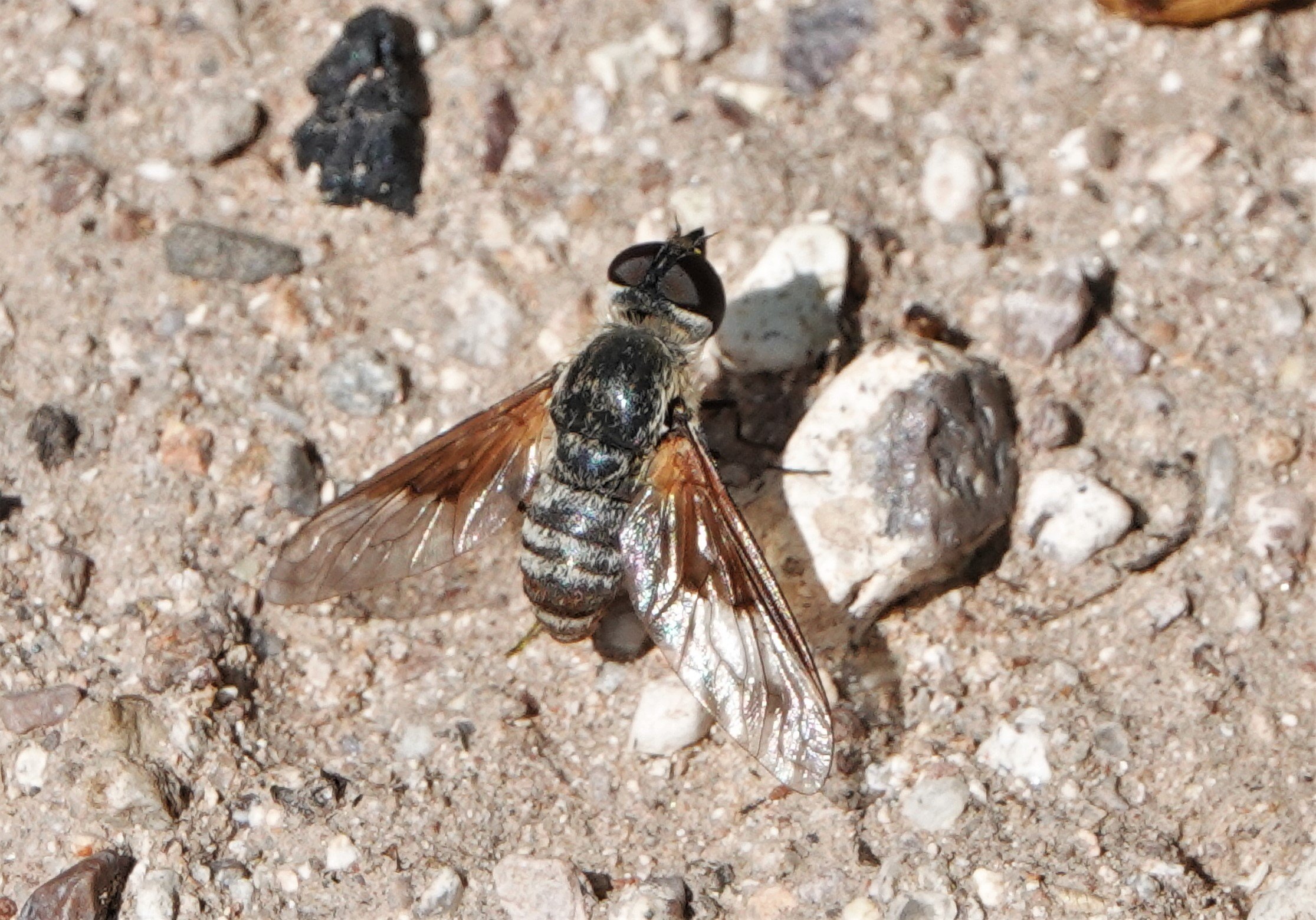
Perhaps undescribed and to be named xanthoptera (description in prep). This species may be more common north of our area in central AZ. Seemingly related to both C. “doblado” and C. yaqui, it has an orange wash to the base of the wings. Segments T3 and T4 on the black abdomen each have a bold white band. It differs from C. “doblado” by having a 50/50 infuscation on the wings, much like C. yaqui. So far, records are quite scarce.
Range: PIMA
Occurs: Late May to Late June
Chrysanthrax yaqui

Note the prominent white band on T3 and narrower white bands on T1 and T7. Most of the ventral pile is black. Also noticeable is the 50/50 dark infuscation on the wings with an overlay of orange, especially basally. Thoracic tomentum is mostly golden. This species perches on vertical as well as horizontal surfaces.
Range: COCH, GREE, PIMA, STCR
Occurs: Early May to Early June
Others - anna & crocinus. Note also the additional taxa related to C. yaqui but apparently unnamed.