In the Field
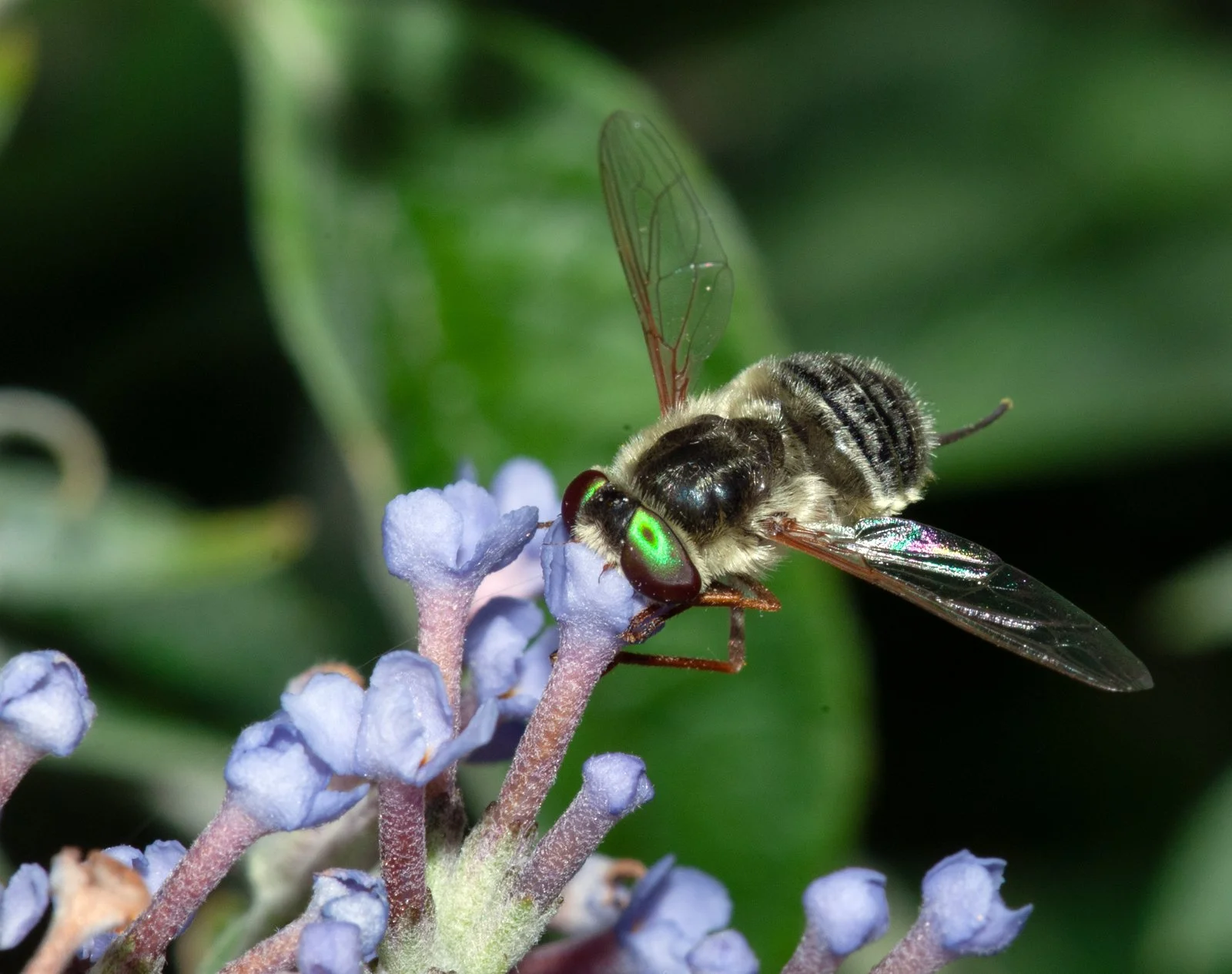
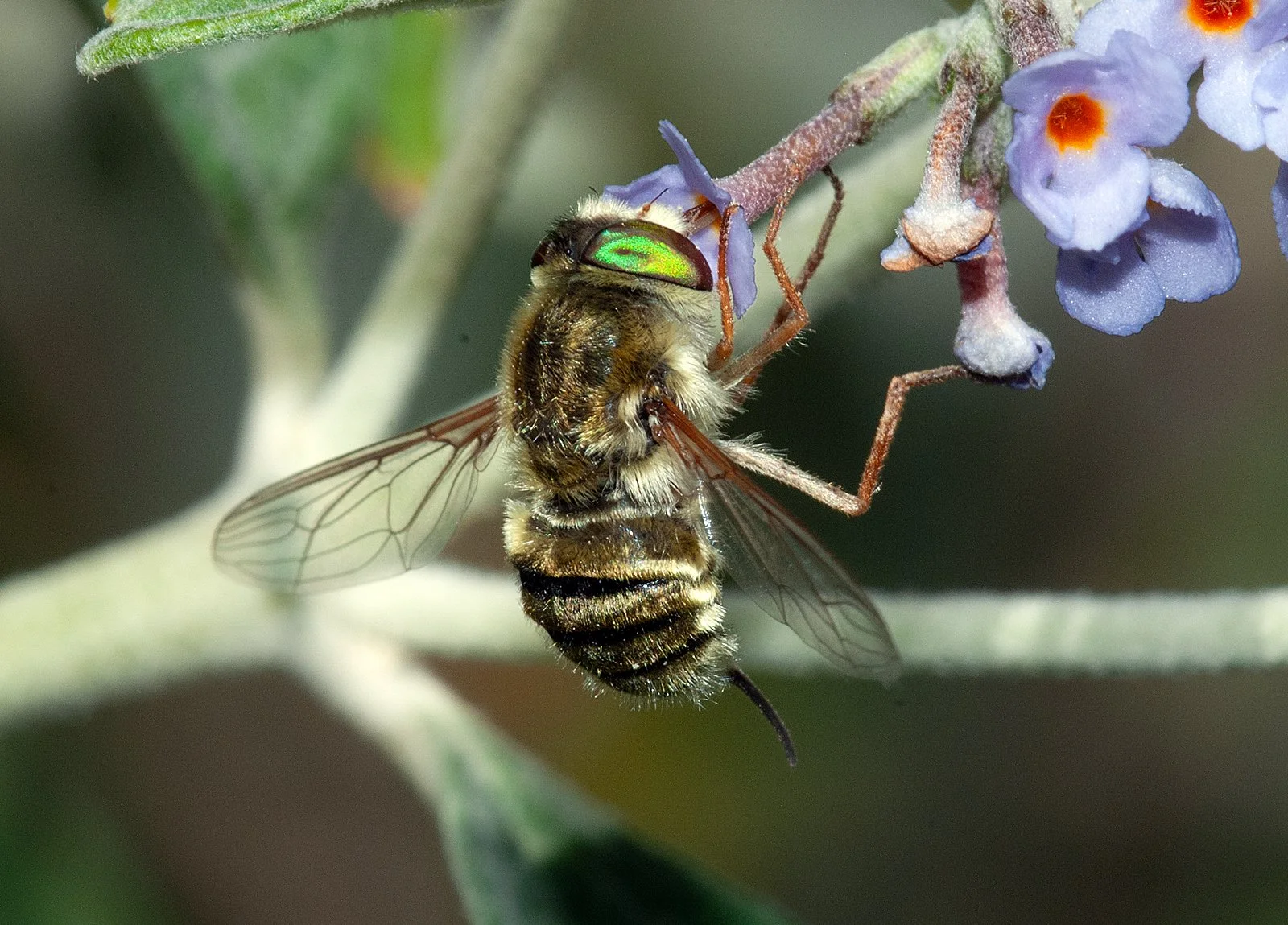
Where should you look for bee flies? Dirt roads in spring and especially mid-summer, grasslands, forests of various types, stream edges, and gardens are all productive sites. Parking lots often contain puddles, especially during the monsoon, and these are well worth investigating for photography (wear knee pads) and collecting. Puddles with muddy margins may attract bee flies at mid-day; i.e., members of the genus Bombylius in the early spring and Parabombylius in mid-summer, and at times will attract species that do not readily visit nectar.
Some bombyliids are hairless; many are densely covered with scales, pile (long hairs), and/or tomentum (short scale-like hairs), all of which are easily removed with careless handling. Care must be used, therefore, when specimens are collected, in order to minimize the loss of these often-colorful adornments, which are usually valuable tools in identification. In a few subfamilies, adults possess strong thoracic bristles (Hall 1981), also an aid to identification. Be aware that certain species show evidence of significant sexual dimorphism in the form of body shape and size, color pattern, and the various scale-like adornments of the adults.
On the wing, bombyliids are typically agile. Many species utilize a slow-moving, hovering flight. A number of other insect orders contain members having the capacity to hover, e.g. Hymenoptera, Lepidoptera, etc. Within the Diptera, many families besides bombyliids; i.e., syrphids, mosquitoes (Culicidae), and tangle-veined flies (Nemestrinidae), are adept at hovering. According to Hull (1973), hovering may be used in the course of mating behaviors, during the search for oviposition sites, and, for those species with long beaks, feeding at flowers. In addition to hovering, most species seem to be capable of bursts of extremely rapid flight, akin to "warp speed" and many fly in direct lines toward other insects or even toward people.
Tangle-veined Fly (Nemestrinidae)
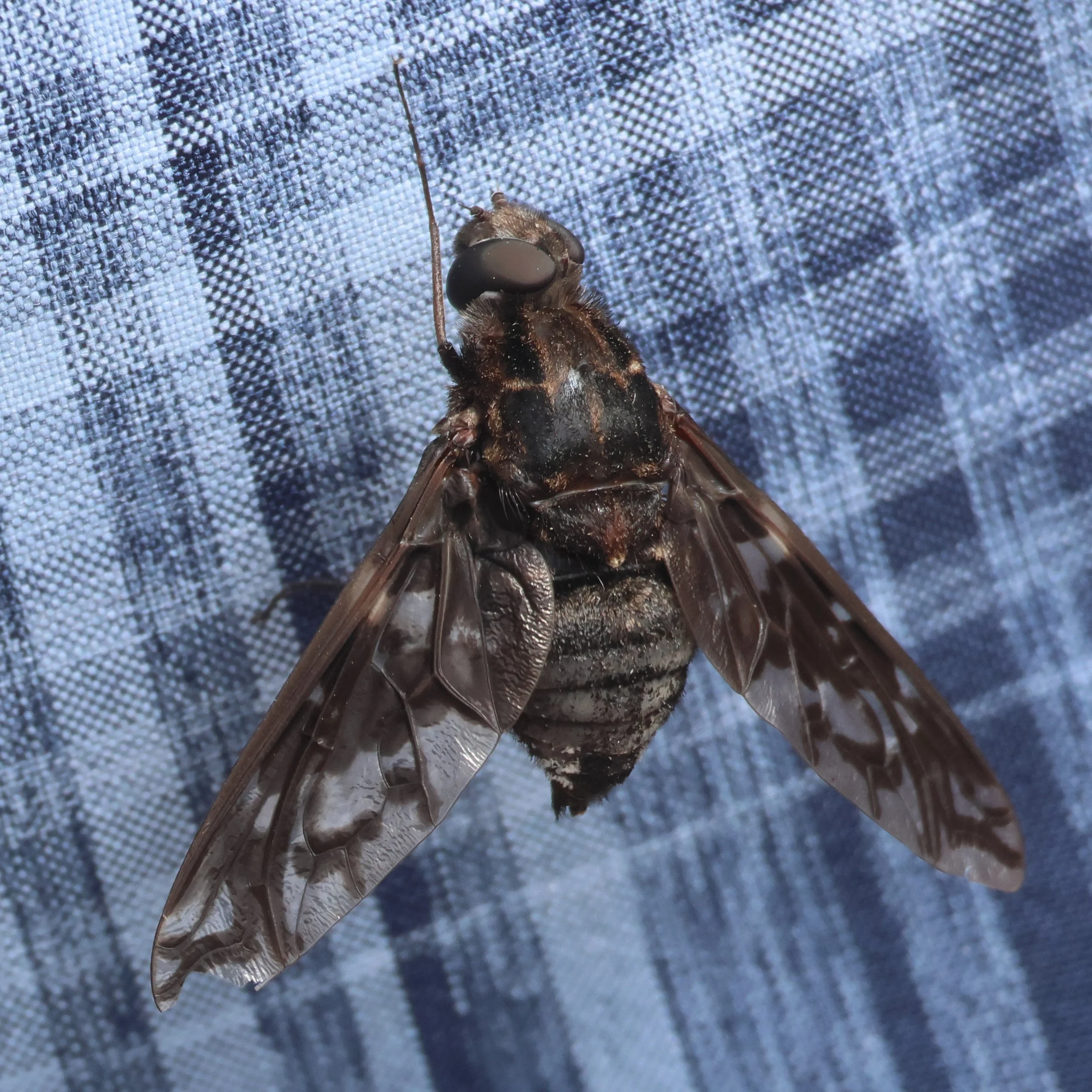
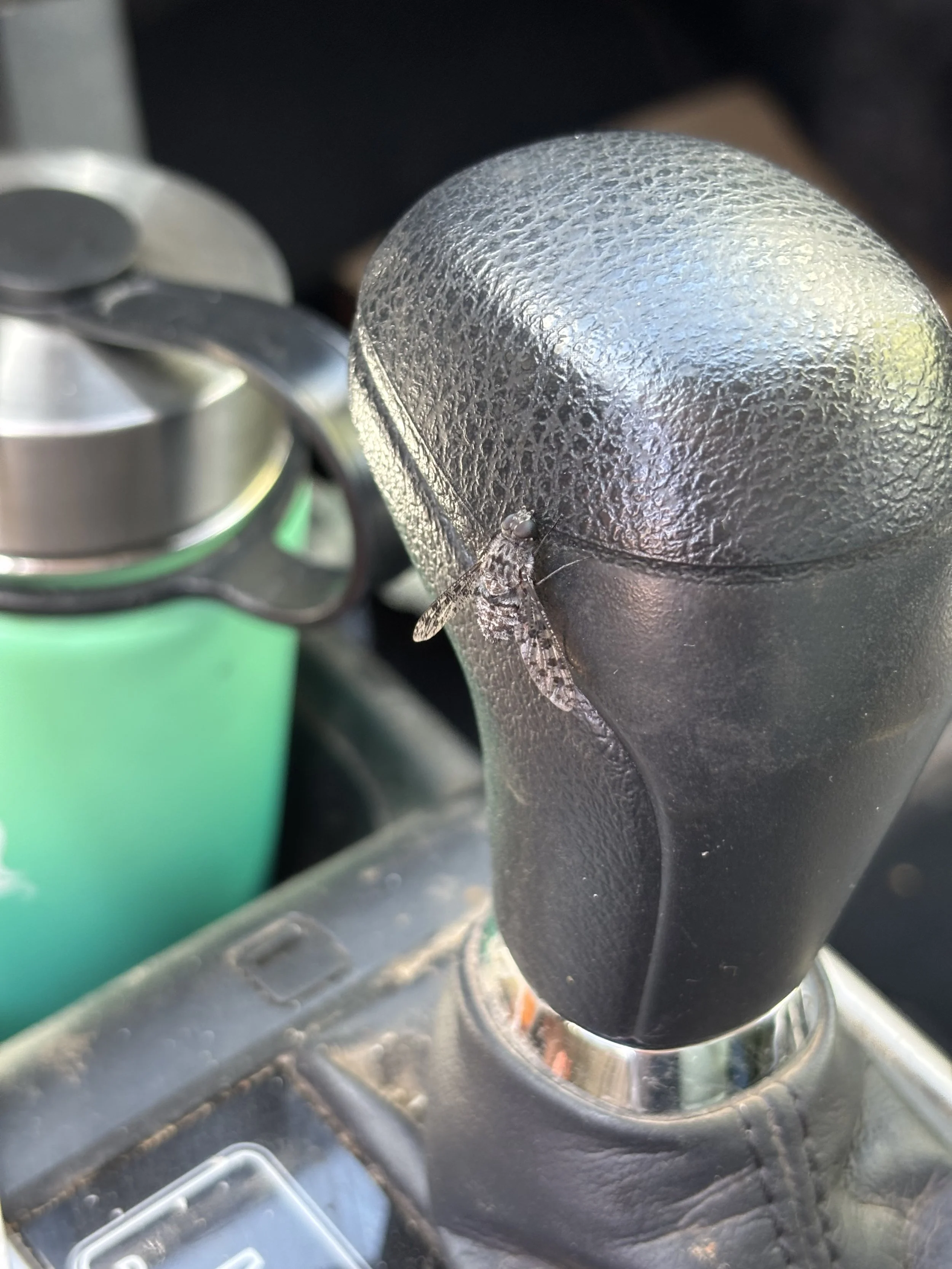
Some species, especially in the genera Anthrax and Xenox, are attracted to people and, in fact, to any vertical surface such as a wall or automobile. The attraction to automobiles is a special case, as cars move, their locations are temporary. Often, after parking along a dirt road, a field worker might return to their vehicle to find a few individuals of several species on or, better yet, near or almost beneath their car. It is unclear whether the color, the shine, the verticality, the heat of the vehicle, the presence of shade, or a combination of these factors is responsible for this attraction, but it is certainly real. Not reliable but real.
Xenox & Anthrax on People & Cars